English
 Español
 tiếng việt
 русский
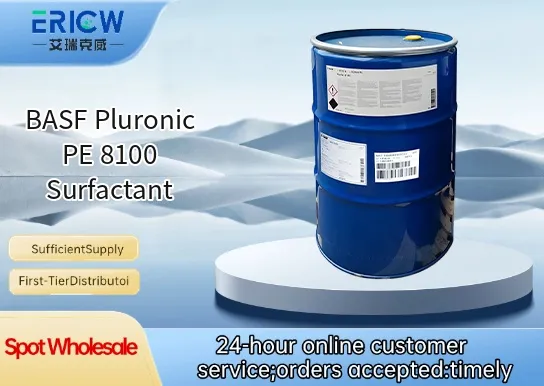
Nonionic triblock copolymer based on poly(ethylene oxide)-poly(propylene oxide)-poly(ethylene oxide) (PEO-PPO-PEO) architecture.
High molecular weight (approx. 8,100 g/mol) providing enhanced steric stabilization in demanding formulations.
Excellent temperature-responsive solubility behavior with well-defined cloud point for controlled release and process tuning.
Low foaming profile suitable for high-shear industrial processes and cleaning-in-place (CIP) applications.
Readily biodegradable and compliant with major global regulatory frameworks including OECD 301 series.
Stabilizer in aqueous polymer dispersions and latex formulations for coatings and adhesives.
Emulsifier and rheology modifier in high-performance industrial cleaners and metalworking fluids.
Protective colloid in nanoparticle synthesis and functional nanocomposites.
Solubilizer and dispersant for hydrophobic actives in agrochemical suspension concentrates (SCs).
Processing aid in pharmaceutical solid dosage forms for wet granulation and tablet coating suspensions.
| Chemical Type | Nonionic PEO-PPO-PEO triblock copolymer |
| Product Form | White to off-white free-flowing granules |
| Appearance | Free-flowing granular solid at room temperature |
| Cloud Point (1% aqueous solution) | ~58–62 °C |
| pH (1% aqueous solution, 25 °C) | 6.0–7.5 |
| Solubility | Freely soluble in water; soluble in polar organic solvents (e.g., ethanol, propylene glycol) |
| Primary Applications | Stabilization, emulsification, solubilization, dispersion |
| Key Features | Thermo-responsive, low foaming, non-ionic, low toxicity |
Q1: What is the primary chemical structure and classification of Pluronic PE 8100?
A: Pluronic PE 8100 is a nonionic triblock copolymer composed of poly(propylene oxide) (PPO) flanked by poly(ethylene oxide) (PEO) end blocks. It belongs to the Pluronic® family of surfactants and is classified as a water-soluble, thermoresponsive amphiphile with intermediate hydrophilic-lipophilic balance.
Q2: In which types of industrial formulations is Pluronic PE 8100 most commonly used?
A: It is frequently employed in agrochemical formulations (e.g., suspension concentrates and emulsifiable concentrates), coatings for improved pigment dispersion and film leveling, and cleaning systems where low-foaming, high-efficiency wetting and solubilization are required. Its thermal responsiveness also supports controlled-release applications.
Q3: How does temperature affect the performance of Pluronic PE 8100 in aqueous solutions?
A: As a thermoresponsive surfactant, Pluronic PE 8100 exhibits reversible micellization upon heating — its solubility decreases with rising temperature, leading to cloud point behavior and increased micellar aggregation. This property is leveraged for temperature-triggered viscosity modulation or phase separation in processing steps.
Q4: Is Pluronic PE 8100 compatible with common ionic surfactants and electrolytes?
A: Yes, it generally shows good compatibility with anionic and cationic surfactants in mixed systems, and tolerates moderate levels of inorganic salts. However, high electrolyte concentrations may lower its cloud point and influence micelle stability — formulation testing under intended use conditions is recommended.
Q5: What are typical handling and storage recommendations for Pluronic PE 8100?
A: Store in original sealed containers at temperatures between 5 °C and 30 °C, protected from direct sunlight and moisture. Avoid freezing, as prolonged exposure to sub-zero temperatures may affect physical homogeneity. Ensure adequate ventilation during handling, and refer to the Safety Data Sheet for occupational hygiene guidance.
Contact With Us:
E-mail: wangxingqiang@ericwchem.com
Have a Questions? Call Us:
Add:
Building A1, Jiete Industrial Park, Huangpu District, Guangzhou City, Guangdong Province, China