English
 Español
 tiếng việt
 русский
High abrasion resistance for extended service life in demanding mechanical environments.
Excellent load-bearing capacity and resilience under repeated dynamic stress.
Good resistance to oils, greases, and many common industrial chemicals.
Smooth, non-tacky surface finish ideal for precision contact applications.
Consistent processing behavior with reliable cure kinetics for repeatable manufacturing.
Roll covers and precision rollers for printing, converting, and paper handling equipment.
Industrial wheels and casters requiring high wear resistance and quiet operation.
Sealing and metering components in fluid handling systems.
Custom-molded elastomeric parts for material handling and automation tooling.
Protective linings and wear pads in mining and bulk material transport equipment.
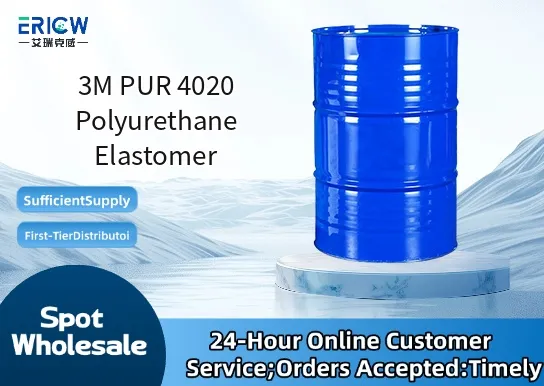
| Chemical Type | Aliphatic polyurethane elastomer |
| Product Form | Two-component liquid system (Part A: polyol blend; Part B: isocyanate) |
| Appearance | Part A: light amber viscous liquid; Part B: pale yellow clear liquid |
| Primary Applications | Roll covers, industrial wheels, precision molded elastomers |
| Key Features | High hardness (Shore D 75–80), low compression set, excellent tear strength |
| Benefits | Dimensional stability, reduced maintenance frequency, improved process uptime |
| Curing Method | Room temperature or elevated temperature post-cure (e.g., 70°C for 4–6 hours) |
| Storage Conditions | Store at 15–25°C in sealed containers; protect from moisture and direct sunlight |
Q1: What is the primary function of 3M PUR 4020 in polyurethane formulations?
A: 3M PUR 4020 is a reactive polyurethane elastomer modifier designed to enhance toughness, abrasion resistance, and dynamic mechanical performance in cast, reaction injection molded (RIM), or thermoset polyurethane systems.
Q2: Is 3M PUR 4020 compatible with aromatic and aliphatic isocyanate systems?
A: Yes — it is formulated for broad compatibility with both aromatic (e.g., MDI, TDI) and aliphatic (e.g., HDI, IPDI) isocyanates, enabling use across a range of performance and weatherability requirements.
Q3: How is 3M PUR 4020 typically incorporated into a polyurethane formulation?
A: It is generally added as a liquid component to the polyol blend prior to mixing with isocyanate. Processing is compatible with standard metering/mixing equipment used for reactive polyurethanes, without requiring special handling or pre-treatment.
Q4: Does 3M PUR 4020 require post-curing to achieve optimal properties?
A: While full property development may benefit from elevated temperature conditioning, it achieves functional crosslink density and mechanical integrity under standard ambient or moderate heat cure conditions typical for polyurethane elastomers.
Q5: Can 3M PUR 4020 be used in applications requiring FDA compliance for indirect food contact?
A: 3M PUR 4020 is not pre-certified for food-contact applications. Formulators must evaluate final cured system compliance per applicable regulatory frameworks, as regulatory status depends on complete formulation, processing, and end-use conditions.
Contact With Us:
E-mail: wangxingqiang@ericwchem.com
Have a Questions? Call Us:
Add:
Building A1, Jiete Industrial Park, Huangpu District, Guangzhou City, Guangdong Province, China