English
 Español
 tiếng việt
 русский
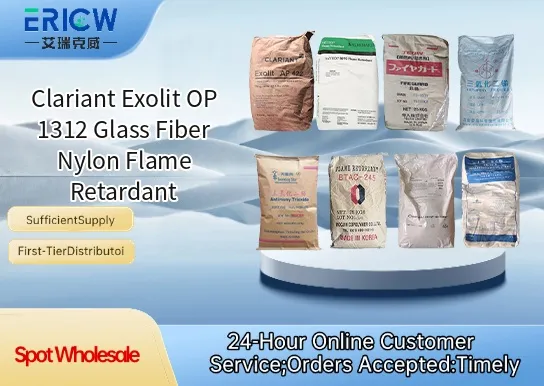
Halogen-free phosphorus-based flame retardant system designed specifically for glass fiber–reinforced polyamide 6 and 66 compounds.
Enables V-0 rating in UL 94 at 1.6 mm thickness without compromising mechanical performance or processability.
Excellent thermal stability up to 280 °C, supporting high-temperature injection molding of engineering plastics.
Low smoke density and reduced toxic gas emission during combustion, meeting stringent fire-safety requirements for enclosed environments.
Good compatibility with common PA6/66 resins and glass fibers, minimizing blooming and maintaining surface aesthetics.
Electrical and electronic housings requiring UL 94 V-0 compliance (e.g., connectors, circuit breakers, junction boxes).
Automotive under-hood components such as sensor housings, fuse boxes, and motor control units.
Railway interior parts including ducting, trim panels, and control module enclosures compliant with EN 45545-2.
Industrial automation housings and power distribution components where low smoke and halogen-free behavior are critical.
| Chemical Type | Organophosphorus compound (phosphinate-based) |
| Product Form | Free-flowing white granules |
| Appearance | Off-white to light beige granules |
| Primary Applications | Glass fiber–reinforced polyamide 6 and 66 |
| Key Features | Halogen-free, RoHS-compliant, REACH registered |
| Recommended Loading Range | 12–18 wt% in PA6/66 + 30% GF |
| UL 94 Rating (1.6 mm) | V-0 (at ≥14 wt% loading in PA66 + 30% GF) |
| Processing Temperature Range | 260–280 °C |
Q1: What is the primary function of Exolit OP 1312 in glass fiber–reinforced nylon compounds?
A: Exolit OP 1312 is a highly efficient, halogen-free flame retardant specifically engineered to impart UL 94 V-0 and V-1 ratings to glass fiber–filled polyamide 6 and polyamide 66 systems, while maintaining good mechanical integrity and processability.
Q2: How does Exolit OP 1312 interact with glass fibers during compounding?
A: Exolit OP 1312 exhibits excellent compatibility with both the polymer matrix and glass fibers, minimizing adverse effects on interfacial adhesion. It does not significantly impair tensile strength or impact performance when properly dispersed, supporting robust structural properties in reinforced applications.
Q3: Is Exolit OP 1312 suitable for injection molding of thin-walled components?
A: Yes — its low volatility, thermal stability up to processing temperatures typical for nylon (up to ~290 °C), and good melt flow behavior make it well-suited for high-speed injection molding, including thin-walled and complex geometries requiring consistent flame retardancy across sections.
Q4: Does Exolit OP 1312 affect the electrical insulation properties of the final compound?
A: No — as an organophosphorus-based additive with non-ionic character, Exolit OP 1312 preserves the high dielectric strength and volume resistivity required for electrical and electronic housing applications, without introducing ionic contaminants or hygroscopic byproducts.
Contact With Us:
E-mail: wangxingqiang@ericwchem.com
Have a Questions? Call Us:
Add:
Building A1, Jiete Industrial Park, Huangpu District, Guangzhou City, Guangdong Province, China