English
 Español
 tiếng việt
 русский
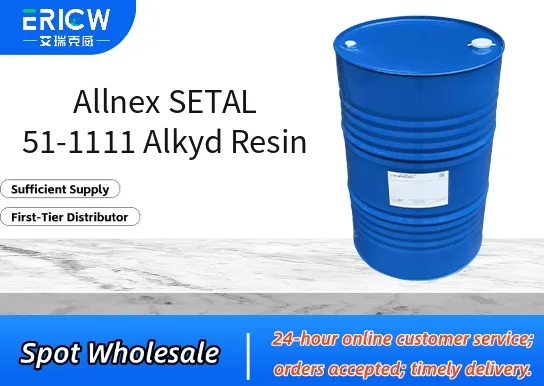
Medium-oil-length alkyd resin based on phthalic anhydride and soybean oil fatty acids.
Designed for excellent through-dry and good hardness development in air-drying systems.
Offers balanced flexibility, gloss retention, and yellowing resistance.
Compatible with common solvents including aromatic hydrocarbons and esters.
Formulated for low VOC compliance in architectural and industrial maintenance coatings.
Interior and exterior architectural paints for wood and metal substrates.
Industrial maintenance coatings for equipment, fences, and structural steel.
General-purpose enamel finishes requiring good flow and leveling.
Repair and touch-up coatings where ambient cure performance is critical.
Decorative varnishes and clear coats for furniture and cabinetry.
| Chemical Type | Phthalic–soybean oil alkyd resin |
| Product Form | Liquid solution in xylene |
| Appearance | Clear, pale yellow to amber liquid |
| Non-Volatile Content (wt%) | ~60% (typical) |
| Acid Value (mg KOH/g) | 6–8 |
| Viscosity (25°C, mPa·s) | 3,000–5,000 (Brookfield RVT, spindle #3, 20 rpm) |
| Density (25°C, g/cm³) | ~0.97–0.99 |
| Primary Applications | Air-drying decorative and protective coatings |
Q1: What is the primary application area for SETAL 51-1111?
A: SETAL 51-1111 is a short-oil alkyd resin designed primarily for high-gloss, durable air-drying decorative and protective coatings, including interior and exterior architectural paints, wood finishes, and general industrial maintenance coatings.
Q2: Is SETAL 51-1111 compatible with common co-resins and additives?
A: Yes, it exhibits good compatibility with melamine-formaldehyde resins, urea-formaldehyde resins, and standard coating additives such as defoamers, rheology modifiers, and wetting agents—though compatibility testing in the final formulation is always recommended.
Q3: How does SETAL 51-1111 contribute to film formation and drying performance?
A: As a reactive alkyd resin, it participates in oxidative crosslinking upon exposure to ambient oxygen, delivering good through-dry, hardness development, and gloss retention—particularly when formulated with appropriate driers and solvents.
Q4: Can SETAL 51-1111 be used in water-reducible systems?
A: It is not inherently water-reducible; however, it may be incorporated into solvent-borne or hybrid systems where partial water substitution is employed—always requiring careful evaluation of stability, viscosity behavior, and film integrity.
Contact With Us:
E-mail: wangxingqiang@ericwchem.com
Have a Questions? Call Us:
Add:
Building A1, Jiete Industrial Park, Huangpu District, Guangzhou City, Guangdong Province, China