English
 Español
 tiếng việt
 русский
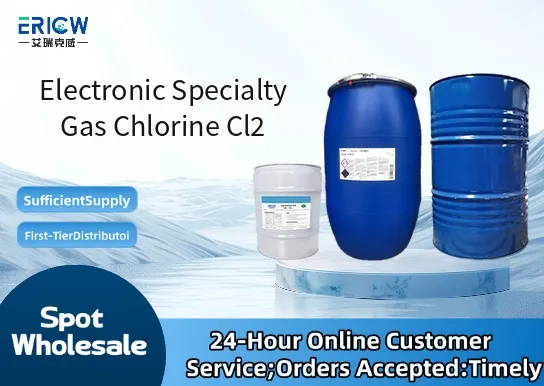
Ultra-high purity (99.999% minimum) with controlled trace impurities (H2O < 0.1 ppm, O2 < 0.1 ppm, hydrocarbons < 0.05 ppm).
Certified electronic-grade consistency per SEMI C37 and ASTM D7582 standards.
Stabilized cylinder packaging with electropolished stainless-steel valves and dual-stage purging to prevent contamination.
Traceable lot documentation including full GC-MS analysis, residual moisture testing, and particulate certification.
Designed for low-outgassing delivery systems and compatible with ultra-clean gas cabinets and abatement interfaces.
Plasma etching of silicon, silicon dioxide, and silicon nitride layers in advanced logic and memory device fabrication.
Chemical vapor deposition (CVD) precursor for metal chloride-based thin-film growth (e.g., TiCl₄, WCl₆ synthesis).
In-situ chamber cleaning for removing silicon-containing residues in PECVD and etch tools.
Doping agent in high-k dielectric processing and selective epitaxial growth environments.
Surface passivation and native oxide removal during pre-deposition wafer conditioning steps.
| Chemical Type | Elemental halogen gas (Cl₂) |
| Product Form | Compressed liquefied gas in high-pressure seamless steel cylinders |
| Appearance | Amber-green gas with pungent odor; visible as yellow-green vapor at room temperature |
| Melting Point | −101.5 °C |
| Boiling Point | −34.04 °C |
| Primary Applications | Semiconductor etching, chamber cleaning, thin-film deposition precursors |
| Key Features | Electronic-grade purity, certified impurity profile, cylinder integrity validation |
| Regulatory Compliance | OSHA HCS, GHS classified (Acute Tox. 2, Skin Corr. 1A, Resp. Sens. 1), REACH registered |
| Common Compatible Systems | Suitability |
| Applied Materials Centura® and Endura® platforms | Highly Recommended – Validated for Cl₂ plasma etch and clean modules |
| Lam Research Kiyo® and Flex® etch systems | Highly Recommended – Certified for high-selectivity SiN/SiO₂ etch processes |
| Tokyo Electron (TEL) Unity® and Speed® series | Recommended – Requires standard Cl₂-compatible gas panel configuration |
| ASM International PECVD and ALD tools | Suitable – Used for in-situ chamber conditioning; verify abatement compatibility |
Q1: What is the CAS Registry Number for electronic-grade chlorine gas?
A: The CAS Number for chlorine (Cl₂) is 7782-50-5. All electronic-grade lots are traceable to this identifier with supplemental lot-specific analytical certificates.
Q2: How does chlorine gas consumption compare to alternative etchants like BCl₃ or SF₆?
A: Cl₂ offers higher etch rates for silicon and silicon compounds versus BCl₃ or SF₆ alone, but is typically used in mixtures (e.g., Cl₂/BCl₃ or Cl₂/O₂) to balance selectivity, anisotropy, and residue control—reducing total mass flow by up to 40% versus pure alternatives.
Q3: Is electronic-grade Cl₂ compliant with SEMI E24 and ISO 14644-1 Class 1 cleanroom handling requirements?
A: Yes—cylinders undergo Class 1 cleanroom assembly, valve sealing under nitrogen purge, and final particulate testing per ISO 14644-1; documentation supports SEMI E24 data exchange protocols.
Q4: Can Cl₂ be safely transferred to a secondary gas cabinet without degradation or contamination?
A: Yes—provided transfer uses electropolished 316L stainless-steel lines, double-block-and-bleed manifolds, and inert gas (N₂ or Ar) purging between connections; moisture ingress and particulate generation must be monitored per SEMI F57.
Contact With Us:
E-mail: wangxingqiang@ericwchem.com
Have a Questions? Call Us:
Add:
Building A1, Jiete Industrial Park, Huangpu District, Guangzhou City, Guangdong Province, China