English
 Español
 tiếng việt
 русский
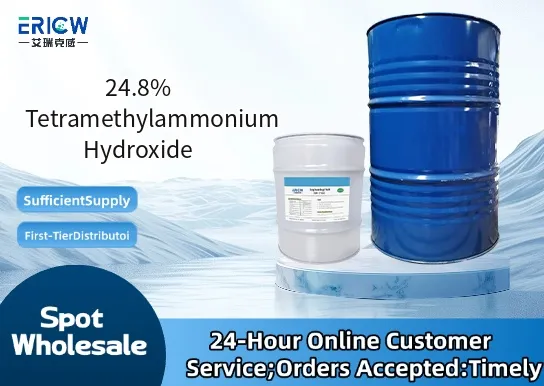
High-purity aqueous solution with precisely controlled 24.8 wt% concentration for consistent process performance.
Non-nucleophilic, strong organic base offering superior selectivity in sensitive deprotection and catalytic reactions.
Low volatility and negligible vapor pressure under ambient conditions—enhances workplace safety and handling stability.
Ultra-low metal impurities (e.g., Na⁺, K⁺, Fe < 10 ppb), critical for semiconductor wafer cleaning and photolithography applications.
Stable at room temperature when stored in sealed, inert containers; compatible with fluoropolymer (e.g., PFA, FEP) and high-density polyethylene (HDPE) packaging.
Photoresist development in advanced semiconductor lithography (e.g., EUV and DUV processes).
Catalyst in phase-transfer reactions, including ester hydrolysis, quaternization, and epoxide ring-opening.
Surface modification agent for silica-based nanomaterials and functionalized glass substrates.
Etchant component in MEMS fabrication for selective silicon dioxide removal.
Buffering and pH adjustment reagent in high-performance liquid chromatography (HPLC) mobile phases.
| Chemical Type | Quaternary ammonium hydroxide |
| Product Form | Aqueous solution |
| Appearance | Clear, colorless to pale yellow liquid |
| Concentration (wt%) | 24.8 ± 0.3% |
| pH (25°C, 1% aqueous) | ≥ 13.5 |
| Key Features | Non-reducing, non-oxidizing, low volatility, thermally stable ≤ 60°C |
| Regulatory Compliance | REACH registered; compliant with ISO 9001 manufacturing controls |
| Storage Recommendation | Store at 15–25°C in opaque, inert containers; protect from CO₂ absorption |
| Common Compatible Systems | Suitability |
| PFA (Perfluoroalkoxy) tubing and tanks | Highly Recommended – Excellent chemical resistance and minimal leachables |
| High-Density Polyethylene (HDPE) containers | Highly Recommended – Standard for bulk storage and dispensing |
| Stainless Steel 316L (passivated) | Recommended – Acceptable for short-term transfer at ambient temperature |
| Quartz and fused silica equipment | Suitable – Chemically inert; requires validation for extended exposure |
Q1: What is the CAS Number for 24.8% Tetramethylammonium Hydroxide?
A: The CAS Number for tetramethylammonium hydroxide monohydrate (common commercial form) is 75-59-2; the 24.8% aqueous solution is supplied as this hydrate-equivalent formulation.
Q2: How should I determine the appropriate dilution or dosage for photoresist development?
A: Optimal dilution depends on resist type, thickness, and process temperature; typical working concentrations range from 0.1% to 2.38% (v/v) in DI water—always validate via dose-to-clear testing and CD uniformity analysis.
Q3: How does 24.8% TMAH compare to sodium hydroxide or KOH in microfabrication etching?
A: Unlike NaOH/KOH, 24.8% TMAH provides anisotropic SiO₂ etching with minimal substrate attack, no metal ion contamination, and higher selectivity—critical for high-resolution pattern transfer and device yield.
Q4: Does this product meet USP or EP requirements for pharmaceutical use?
A: This grade is manufactured under ISO 9001 and meets SEMI C12 purity standards; it is not certified to USP/EP monographs and is not intended for direct pharmaceutical excipient use without further qualification.
Q5: Is there risk of TMAH migration into processed wafers or packaging materials?
A: Migration is negligible under standard processing conditions; however, prolonged contact with certain polymers (e.g., PET, PVC) may cause degradation—use only validated inert materials (PFA, HDPE, quartz) for storage and delivery.
Contact With Us:
E-mail: wangxingqiang@ericwchem.com
Have a Questions? Call Us:
Add:
Building A1, Jiete Industrial Park, Huangpu District, Guangzhou City, Guangdong Province, China