English
 Español
 tiếng việt
 русский
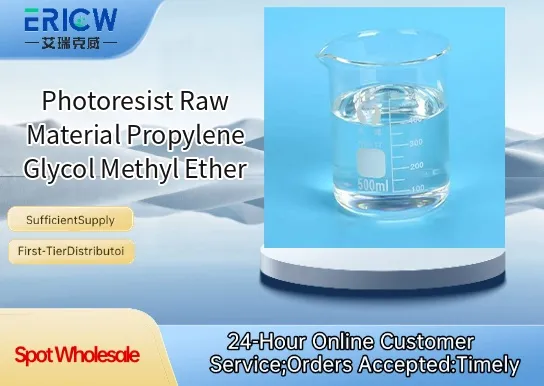
High solvency power for novolac resins and photoacid generators (PAGs) in g-line/i-line and KrF photoresists.
Low volatility and favorable evaporation rate enabling uniform film formation during spin-coating.
Excellent water miscibility and compatibility with common co-solvents (e.g., PGMEA, EL, cyclohexanone).
Ultra-low ionic impurities (Na⁺, K⁺, Cl⁻ < 10 ppb) meeting semiconductor-grade purity requirements.
Stable chemical structure under ambient storage conditions; non-reactive with typical photoresist polymer matrices.
Primary solvent in positive-tone g-line and i-line photoresists for IC fabrication.
Co-solvent component in advanced KrF (248 nm) deep-UV photoresist formulations.
Carrier medium for resist additives including dissolution inhibitors and surfactants.
Formulation ingredient in OLED display photolithography materials for high-resolution patterning.
Processing aid in MEMS and compound semiconductor device manufacturing processes.
| Chemical Type | Monofunctional glycol ether |
| Product Form | Clear, colorless liquid |
| Appearance | Transparent, free of suspended matter or haze |
| Melting Point | −85 °C |
| Boiling Point (760 mmHg) | 120–122 °C |
| Primary Applications | Photoresist solvent, co-solvent, and diluent in semiconductor lithography |
| Key Features | Low toxicity profile, low surface tension, high resist solubility, controlled evaporation |
| Regulatory Compliance | REACH registered; RoHS compliant; no SVHCs above threshold per EU Annex XIV |
| Common Compatible Systems | Suitability |
| Novolac resin-based g/i-line resists | Highly Recommended – Optimal solvation and film uniformity |
| KrF chemically amplified resists (CARs) | Highly Recommended – Compatible with PAGs and acid-labile polymers |
| Acrylic-based EUV resist platforms | Recommended – Requires blending with higher-boiling solvents for optimal coating |
| Industrial inkjet photoresist inks | Suitable – Effective carrier with acceptable jetting stability and drying kinetics |
Q1: What is the CAS number for Propylene Glycol Methyl Ether used in photoresist applications?
A: The CAS Registry Number is 108-65-6 (1-methoxy-2-propanol), corresponding to the technical-grade isomer mixture predominantly used in lithographic solvents.
Q2: What is the typical recommended usage concentration in photoresist formulations?
A: Typically used at 85–95 wt% in final resist solutions, often blended with 2–10 wt% co-solvents (e.g., ethyl lactate or propylene glycol methyl ether acetate) to fine-tune drying behavior.
Q3: How does PGME compare to PGMEA in photoresist performance?
A: PGME offers lower boiling point and faster evaporation than PGMEA, resulting in shorter soft-bake times—but requires tighter process control to avoid edge bead effects. PGMEA provides better film leveling; PGME excels in high-throughput applications requiring rapid solvent removal.
Q4: Is this material subject to any migration or leaching concerns in final devices?
A: Residual PGME is effectively removed during standard post-apply bake (PAB) at 90–110 °C; validated by FTIR and GC-MS analysis showing < 5 ppm residual content in cured films—well below industry thresholds for metal contamination or outgassing-induced defects.
Contact With Us:
E-mail: wangxingqiang@ericwchem.com
Have a Questions? Call Us:
Add:
Building A1, Jiete Industrial Park, Huangpu District, Guangzhou City, Guangdong Province, China