English
 Español
 tiếng việt
 русский
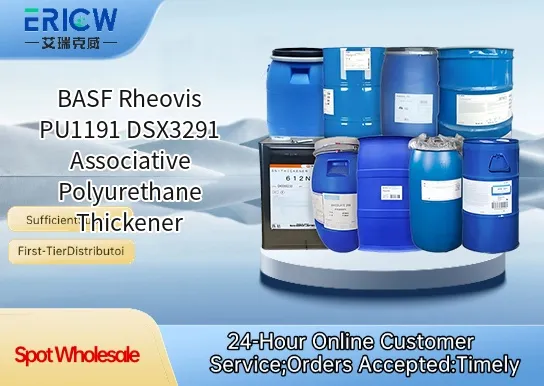
Delivers excellent rheology control with strong pseudoplastic behavior and high low-shear viscosity for sag resistance.
Provides outstanding compatibility with anionic and nonionic surfactants, co-thickeners, and common paint additives.
Enables efficient thickening in both waterborne acrylic and styrene-acrylic emulsion systems without compromising film formation.
Offers superior spatter resistance and brush/roller drag performance in architectural coatings.
Delivers good storage stability and freeze-thaw resistance in formulated paints and coatings.
Architectural interior and exterior wall paints (low-VOC and zero-VOC formulations).
Waterborne industrial maintenance coatings for metal and concrete substrates.
Decorative wood finishes and clear varnishes requiring clarity and flow control.
Textured coatings and structured effect paints where controlled rheology is critical.
Adhesives and sealants requiring viscosity build and anti-drip performance.
| Chemical Type | Associative polyurethane (HEUR) |
| Product Form | Aqueous dispersion |
| Appearance | Opaque white to off-white liquid |
| pH (1% aqueous solution) | 6.5 – 7.5 |
| Solids Content (wt %) | 30.0 ± 1.0 |
| Density (20 °C) | 1.02 – 1.04 g/cm³ |
| Viscosity (Brookfield RVT, spindle #3, 20 rpm, 25 °C) | 1,500 – 3,500 mPa·s |
| Primary Applications | Rheology modifier for waterborne coatings and construction chemicals |
Q1: What is the primary function of Rheovis PU1191 DSX3291 in waterborne formulations?
A: Rheovis PU1191 DSX3291 is an associative polyurethane (HEUR) rheology modifier designed to provide efficient viscosity control and strong shear-thinning behavior in water-based systems, particularly enhancing sag resistance, leveling, and brush/roller application performance.
Q2: How does this thickener differ from cellulosic or acrylic thickeners?
A: Unlike non-associative thickeners, Rheovis PU1191 DSX3291 functions via hydrophobic association in aqueous media, delivering superior flow and leveling, lower sensitivity to electrolytes, and improved compatibility with surfactants and co-solvents commonly found in architectural and industrial coatings.
Q3: Is Rheovis PU1191 DSX3291 suitable for use in low-VOC or zero-VOC formulations?
A: Yes — it is a solvent-free, APEO-free, and VOC-compliant rheology modifier, making it well-suited for modern low- and zero-VOC coating systems without compromising performance or regulatory compliance.
Q4: What is the typical dosage range and addition method?
A: It is typically used at low concentrations, generally ranging from 0.1% to 2% by weight of the total formulation, and is best added during the let-down stage under moderate agitation to ensure uniform dispersion and optimal associative network development.
Contact With Us:
E-mail: wangxingqiang@ericwchem.com
Have a Questions? Call Us:
Add:
Building A1, Jiete Industrial Park, Huangpu District, Guangzhou City, Guangdong Province, China