English
 Español
 tiếng việt
 русский
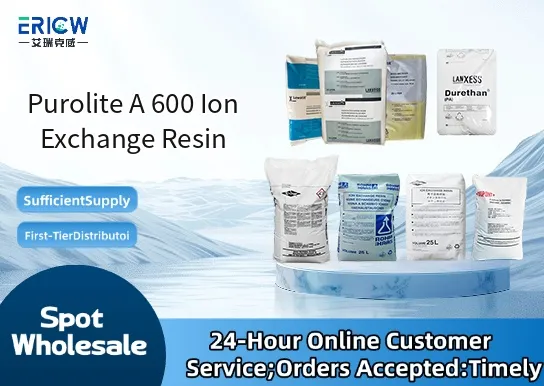
High-capacity, strongly basic anion exchange resin with Type I functionalization.
Exceptional chemical stability and resistance to oxidation, ensuring long service life in demanding environments.
Uniform spherical bead morphology for low pressure drop and optimal hydraulic performance.
Low total organic carbon (TOC) extractables, meeting stringent requirements for pharmaceutical and ultrapure water applications.
Consistent particle size distribution (U.S. Standard Sieve Series) for predictable column packing and flow dynamics.
Final polishing step in pharmaceutical-grade purified water (PW) and water-for-injection (WFI) systems.
Nitrate and sulfate removal from municipal and industrial drinking water supplies.
Silica scavenging in high-purity boiler feedwater treatment.
Anion removal in electronics manufacturing ultrapure water (UPW) loops.
Pre-treatment for reverse osmosis (RO) systems to protect membranes from anionic fouling.
| Chemical Type | Strongly Basic Anion Exchange Resin (Type I) |
| Product Form | Moist, spherical beads |
| Appearance | Off-white to light yellow, uniform beads |
| Functional Group | Quaternary ammonium (–N(CH₃)₃⁺) |
| Ion Form | Chloride (Cl⁻) |
| Moisture Content | 48 – 55% (as shipped) |
| Particle Size Range | 0.3 – 1.2 mm (95% retained on 16 mesh, passes 50 mesh) |
| Uniformity Coefficient | ≤ 1.7 |
Q1: What is the primary functional group and ion exchange capacity of Purolite A 600?
A: Purolite A 600 is a strong base anion exchange resin with a Type I quaternary ammonium functional group. Its total exchange capacity is typically in the range of 1.2–1.4 eq/L (dry), depending on operating conditions and regeneration efficiency.
Q2: Is Purolite A 600 suitable for pharmaceutical or food-grade water purification applications?
A: Yes — Purolite A 600 is manufactured to meet USP General Chapter <643> requirements for purified water systems and complies with FDA 21 CFR §173.25 for indirect food additives. It is widely used in deionization trains for WFI and purified water generation where high chloride selectivity and low leachables are critical.
Q3: How does Purolite A 600 compare to standard gel-type strong base anion resins in terms of nitrate removal efficiency?
A: Due to its macroporous structure and optimized quaternary ammonium functionality, Purolite A 600 exhibits enhanced selectivity for nitrate over sulfate and bicarbonate compared to conventional gel-type resins — especially in waters with moderate to high sulfate content. This makes it particularly effective in municipal and agricultural water treatment where nitrate contamination is a concern.
Q4: What are the recommended storage conditions and shelf life for unused Purolite A 600 resin?
A: Store in original sealed packaging at temperatures between 2 °C and 35 °C, away from direct sunlight and oxidizing agents. When stored properly, the resin maintains full performance for up to 24 months from the date of manufacture. Avoid freezing, as ice formation may damage the bead structure.
Contact With Us:
E-mail: wangxingqiang@ericwchem.com
Have a Questions? Call Us:
Add:
Building A1, Jiete Industrial Park, Huangpu District, Guangzhou City, Guangdong Province, China