English
 Español
 tiếng việt
 русский
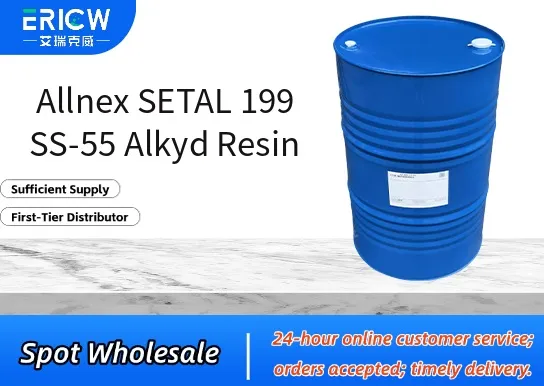
Fast-drying, medium-oil modified alkyd resin designed for high-solids solventborne coatings.
Excellent gloss retention and film hardness development at ambient cure conditions.
Good compatibility with common nitrocellulose, acrylic, and melamine resins.
Low viscosity enables formulation flexibility and improved solids content without sacrificing application properties.
Consistent batch-to-batch performance supported by Allnex’s stringent quality control protocols.
Automotive refinish topcoats and clearcoats.
Industrial maintenance coatings for metal and wood substrates.
General-purpose decorative enamels and protective finishes.
Coil coating primer-surfacers requiring balanced drying and sandability.
Marine and rail OEM coatings where durability and weather resistance are critical.
| Chemical Type | Medium-oil, soybean oil-modified alkyd resin |
| Product Form | Liquid |
| Appearance | Clear to pale yellow viscous liquid |
| Solvent | Xylene / Solvesso™ 100 (typical) |
| Non-Volatile Content (NV%) | ~55% (as supplied) |
| Viscosity (DIN 4, 23°C) | ~15–25 s |
| Acid Value | 6–10 mg KOH/g |
| Key Features | Ambient-cure capability, high gloss potential, low VOC formulation support |
Q1: What is the primary application area for SETAL 199 SS-55?
A: SETAL 199 SS-55 is a solvent-based short-oil alkyd resin specifically designed for high-performance industrial maintenance and protective coatings, including metal primers, topcoats, and general-purpose enamel systems where good gloss retention, flexibility, and corrosion resistance are required.
Q2: Is SETAL 199 SS-55 compatible with common crosslinkers used in two-component systems?
A: Yes — it is formulated to be compatible with standard amino resins (e.g., melamine-formaldehyde) and isothermal curing agents, enabling use in baked finishes. It may also be blended with other alkyds or modified resins to tailor drying speed and film properties, though compatibility testing is recommended for each specific formulation.
Q3: How does SETAL 199 SS-55 perform in terms of drying behavior and film formation?
A: As a short-oil alkyd, it offers relatively fast air-drying characteristics with good through-dry and hardness development. Film formation yields balanced toughness and flexibility, supporting applications requiring resistance to mechanical stress and thermal cycling without excessive brittleness.
Q4: Can SETAL 199 SS-55 be used in low-VOC formulations?
A: While inherently solvent-based, it can contribute to VOC-reduced systems when formulated with high-solids solvents or integrated into hybrid architectures (e.g., with acrylic dispersions or waterborne co-binders), subject to regulatory compliance and performance validation in the final coating matrix.
Contact With Us:
E-mail: wangxingqiang@ericwchem.com
Have a Questions? Call Us:
Add:
Building A1, Jiete Industrial Park, Huangpu District, Guangzhou City, Guangdong Province, China