English
 Español
 tiếng việt
 русский
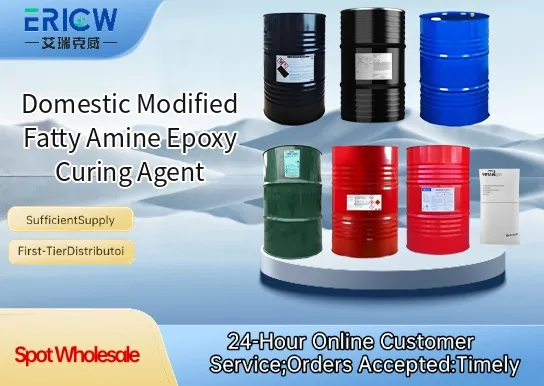
Enhanced flexibility and reduced brittleness in cured epoxy systems.
Improved compatibility with standard bisphenol-A and bisphenol-F epoxy resins.
Lower volatility and reduced amine odor compared to conventional aliphatic amines.
Good pot life at ambient temperature (20–25°C) with controllable gel time.
Excellent adhesion to metals, concrete, and composite substrates.
Structural adhesives for automotive and rail assembly.
Protective coatings for industrial flooring and marine infrastructure.
Electrical encapsulants and insulating compounds for power equipment.
Repair mortars and anchoring grouts in civil engineering projects.
Composite matrix resins for wind blade bonding and pultrusion profiles.
| Chemical Type | Modified fatty amine adduct |
| Product Form | Liquid |
| Appearance | Pale yellow to amber transparent liquid |
| Amine Value | 380–420 mg KOH/g |
| Viscosity (25°C) | 300–600 mPa·s |
| Density (25°C) | 0.92–0.96 g/cm³ |
| Reactivity Profile | Room-temperature curable; exotherm peak ~70–90°C |
| Storage Stability | 12 months in sealed container at 5–30°C |
Q1: What are the key advantages of this modified fatty amine curing agent compared to conventional aliphatic amines?
A: This domestic modified fatty amine offers improved compatibility with epoxy resins, reduced volatility and skin sensitization potential, and enhanced flexibility in cured films—without sacrificing reactivity at ambient or moderately elevated temperatures.
Q2: Is this curing agent suitable for high-solids or solvent-free epoxy formulations?
A: Yes—it is specifically engineered for low-viscosity, high-reactivity performance in high-solids and 100% solids epoxy systems, supporting good pot life and efficient crosslinking without excessive exotherm.
Q3: How does humidity affect its curing performance?
A: While it exhibits better moisture tolerance than many unmodified amines, prolonged exposure to high relative humidity during cure may delay surface dryness and affect final film integrity—therefore, controlled ambient conditions are recommended for optimal results.
Q4: Can it be used in coatings requiring FDA-compliant food-contact approval?
A: This product is not pre-certified for food-contact applications; formulation-level compliance requires full evaluation—including extraction testing and regulatory review—by the end-user’s qualified toxicologist or regulatory affairs team.
Contact With Us:
E-mail: wangxingqiang@ericwchem.com
Have a Questions? Call Us:
Add:
Building A1, Jiete Industrial Park, Huangpu District, Guangzhou City, Guangdong Province, China