English
 Español
 tiếng việt
 русский
High reactivity with formaldehyde and melamine-based crosslinkers for rapid cure kinetics.
Excellent compatibility with acrylic, polyester, and alkyd resin systems.
Superior thermal stability and chemical resistance in cured coatings.
Low free formaldehyde content, supporting VOC-compliant formulation strategies.
Consistent batch-to-batch performance ensured by INEOS’s proprietary manufacturing control.
Automotive OEM and refinish topcoats requiring high-gloss, chip-resistant finishes.
Industrial coil coatings for pre-painted metal substrates.
Appliance enamel coatings demanding excellent hardness and detergent resistance.
Can coatings for food and beverage packaging where FDA-compliant curing is essential.
General-purpose baking enamels for metal furniture and hardware.
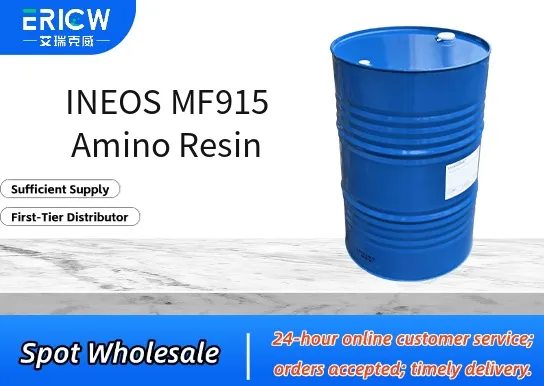
| Chemical Type | Melamine-formaldehyde condensate |
| Product Form | Clear to pale yellow liquid |
| Appearance | Homogeneous, low-viscosity solution |
| Solvent Content | Butanol/water mixture (approx. 60–65% solids) |
| pH (10% aqueous solution) | 7.5–8.5 |
| Free Formaldehyde | <0.3 wt% |
| Storage Stability | ≥12 months at 5–25°C in sealed container |
| Primary Applications | Baking finish crosslinker for metal coatings |
Q1: What is the primary function of INEOS MF915 in coating formulations?
A: INEOS MF915 is a melamine-formaldehyde amino resin designed primarily as a crosslinking agent for thermosetting coatings. It reacts with hydroxyl- and carboxyl-functional resins—such as acrylics, alkyds, or polyesters—to form durable, heat-resistant, and chemically robust networks upon curing.
Q2: Is INEOS MF915 suitable for low-bake or ambient-cure systems?
A: INEOS MF915 is formulated for conventional thermal cure conditions, typically requiring baking temperatures between 120 °C and 160 °C. While it can be modified with catalysts to reduce cure temperature, it is not inherently optimized for true ambient-cure applications without formulation adjustments.
Q3: How does INEOS MF915 compare to other melamine resins in terms of compatibility and storage stability?
A: INEOS MF915 offers broad compatibility with common solvent-based and high-solids resin systems, and demonstrates good shelf life under recommended storage conditions (cool, dry, and well-ventilated). Its balanced reactivity profile helps minimize premature gelation while maintaining efficient crosslink density during cure.
Q4: What types of catalysts are commonly used with INEOS MF915?
A: Acidic catalysts—such as p-toluenesulfonic acid (pTSA), blocked acids, or weak organic acids—are frequently employed to accelerate the crosslinking reaction. Catalyst selection and dosage depend on the desired pot life, cure schedule, and final film properties, and should be evaluated case by case during formulation development.
Contact With Us:
E-mail: wangxingqiang@ericwchem.com
Have a Questions? Call Us:
Add:
Building A1, Jiete Industrial Park, Huangpu District, Guangzhou City, Guangdong Province, China