English
 Español
 tiếng việt
 русский
High reactivity with hydroxyl-functional resins, enabling efficient crosslinking at moderate cure temperatures.
Low formaldehyde emission profile, supporting compliance with stringent environmental and occupational health regulations.
Excellent compatibility with acrylic, polyester, and alkyd resin systems for broad formulation flexibility.
Good storage stability in solvent-based systems when properly inhibited and handled under recommended conditions.
Delivers superior hardness, chemical resistance, and gloss retention in thermoset coatings.
Automotive OEM clearcoats and basecoats requiring high durability and appearance performance.
Industrial maintenance coatings for metal substrates exposed to harsh environments.
Appliance coatings demanding excellent mar resistance and long-term color stability.
General-purpose coil coatings where balanced cure speed and film integrity are critical.
Can and closure coatings requiring low migration and FDA-compliant food-contact suitability (when formulated accordingly).
| Chemical Type | Methylated melamine-formaldehyde resin |
| Product Form | Liquid |
| Appearance | Clear, pale yellow liquid |
| Solvent Content | Approx. 65–70% (isobutanol/butanol blend) |
| Non-Volatile Content | 30–33% (by weight, ASTM D1209) |
| Viscosity (25°C) | 15–25 mPa·s (ASTM D445) |
| Acid Number | < 1.0 mg KOH/g (ASTM D1613) |
| Specific Gravity (25°C) | 0.92–0.95 g/cm³ (ASTM D1475) |
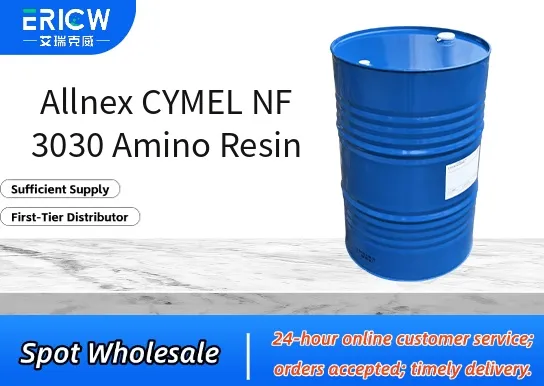
Q1: What is the primary function of CYMEL NF 3030 in coating formulations?
A: CYMEL NF 3030 is a highly reactive, low-viscosity melamine-formaldehyde crosslinker designed to enhance hardness, chemical resistance, and thermal stability in thermosetting coatings—particularly in coil, automotive, and general industrial applications based on polyester, acrylic, or alkyd resins.
Q2: Is CYMEL NF 3030 compatible with acid-catalyzed systems?
A: Yes, it is formulated for use with conventional strong acid catalysts (e.g., p-toluenesulfonic acid) and latent catalysts. Its reactivity profile allows for good pot life control and efficient cure at typical baking temperatures between 140–180 °C, depending on formulation and substrate.
Q3: How should CYMEL NF 3030 be stored to maintain stability?
A: Store in tightly sealed original containers in a cool, dry, and well-ventilated area below 30 °C. Avoid prolonged exposure to moisture, high humidity, or temperatures above 40 °C, as these may promote premature condensation or viscosity increase.
Q4: Does CYMEL NF 3030 contain free formaldehyde?
A: It contains only trace levels of residual formaldehyde, consistent with industry standards for modern amino resins. The product is stabilized to minimize formaldehyde release during storage and handling, though standard industrial hygiene practices for formaldehyde-containing materials should still be observed.
Q5: Can CYMEL NF 3030 be used in low-bake or UV-assisted curing systems?
A: While primarily optimized for conventional thermal cure, it can be incorporated into hybrid low-bake systems when paired with reactive co-crosslinkers or catalysts that lower activation energy. However, full cure performance at temperatures below 130 °C is formulation-dependent and requires empirical validation.
Contact With Us:
E-mail: wangxingqiang@ericwchem.com
Have a Questions? Call Us:
Add:
Building A1, Jiete Industrial Park, Huangpu District, Guangzhou City, Guangdong Province, China