English
 Español
 tiếng việt
 русский
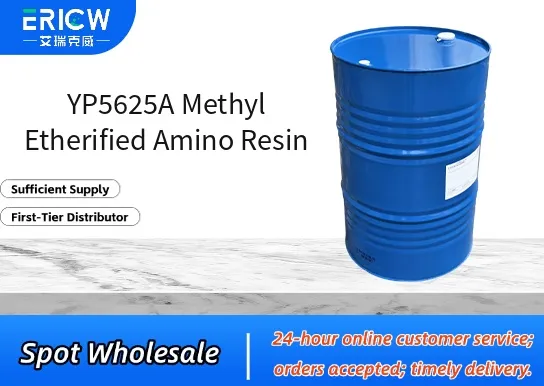
Excellent compatibility with polyester, acrylic, and alkyd resins for broad formulation flexibility.
Low formaldehyde emission profile, supporting compliance with stringent environmental and occupational health standards.
Fast curing kinetics at moderate bake temperatures (140–160 °C), enabling high-throughput industrial coating processes.
Superior gloss retention and chemical resistance in finished thermoset coatings.
Good storage stability as a clear to pale yellow liquid with minimal viscosity change over 6 months at ambient conditions.
Automotive OEM and refinish topcoats requiring high durability and aesthetic performance.
Appliance coatings for refrigerators, washing machines, and ovens.
Industrial coil coatings on pre-painted metal substrates.
General-purpose can and container coatings for food and beverage packaging.
High-performance wood finishing systems for furniture and cabinetry.
| Chemical Type | Methyl etherified melamine-formaldehyde resin |
| Product Form | Liquid |
| Appearance | Clear to pale yellow, homogeneous liquid |
| Solids Content (wt%) | 80 ± 1 |
| Viscosity (mPa·s, 25 °C) | 800–1,200 |
| Acid Number (mg KOH/g) | < 5.0 |
| Density (g/cm³, 25 °C) | 1.18–1.22 |
| pH (10% aqueous solution) | 7.5–8.5 |
Q1: What is the primary function of YP5625A in coating and ink formulations?
A: YP5625A serves as a crosslinking agent that enhances hardness, chemical resistance, and thermal stability in thermosetting systems—particularly in ambient-cure or low-bake acrylic, polyester, and alkyd-based coatings and inks.
Q2: How does YP5625A differ from other methylated melamine-formaldehyde resins?
A: YP5625A features a balanced degree of methylation and controlled molecular weight, offering improved compatibility with hydroxyl-functional resins and reduced volatility compared to highly etherified analogues—supporting better storage stability and smoother film formation.
Q3: Is YP5625A suitable for waterborne systems?
A: Yes—YP5625A exhibits good miscibility in water-reducible and hybrid solvent–water systems when properly formulated with co-solvents and pH stabilization, though performance optimization requires compatibility testing with specific resin dispersions.
Q4: What are typical handling and storage recommendations?
A: Store in tightly sealed containers at temperatures between 5 °C and 30 °C, away from strong acids, bases, and excessive humidity. Prolonged exposure to moisture or extreme pH may lead to premature condensation or viscosity increase.
Contact With Us:
E-mail: wangxingqiang@ericwchem.com
Have a Questions? Call Us:
Add:
Building A1, Jiete Industrial Park, Huangpu District, Guangzhou City, Guangdong Province, China