English
 Español
 tiếng việt
 русский
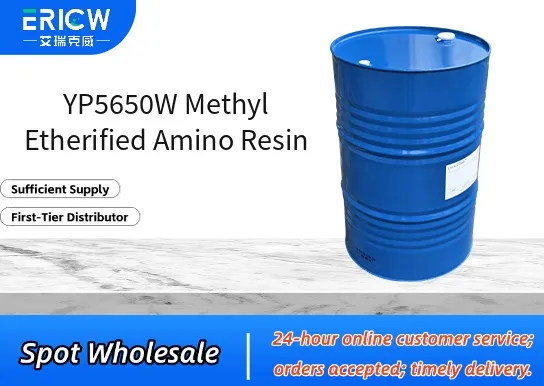
High reactivity with hydroxyl and carboxyl functional groups for efficient crosslinking.
Excellent compatibility with acrylic, polyester, and alkyd resin systems.
Low formaldehyde release profile meeting stringent environmental compliance standards.
Good storage stability at ambient temperature without gelling or viscosity drift.
Enables fast cure kinetics under conventional baking conditions (140–160 °C).
Automotive OEM and refinish topcoats requiring high gloss and durability.
Industrial coil coatings for metal roofing, appliances, and building panels.
Can coatings for food and beverage containers with FDA-compliant formulations.
Wood furniture and cabinetry finishes demanding hardness and chemical resistance.
General-purpose baked enamels for metal substrates in architectural and hardware applications.
| Chemical Type | Methyl etherified melamine-formaldehyde resin |
| Product Form | Liquid |
| Appearance | Clear, colorless to pale yellow liquid |
| Solids Content (wt%) | 80 ± 1 |
| Viscosity (mPa·s, 25 °C) | 1,200–1,800 |
| Acid Number (mg KOH/g) | < 5.0 |
| Density (g/cm³, 25 °C) | 1.22–1.26 |
| Primary Applications | Crosslinker for thermosetting coatings on metal and wood |
Q1: What is the primary function of YP5650W in coating formulations?
A: YP5650W serves as a crosslinking agent for hydroxyl-functional resins—such as acrylics, polyesters, and alkyds—enabling thermoset film formation with enhanced hardness, chemical resistance, and thermal stability under standard curing conditions.
Q2: How does YP5650W differ from other methyl etherified melamine-formaldehyde resins?
A: YP5650W features a tailored degree of methylation and controlled molecular weight distribution, offering improved compatibility with polar resin systems and reduced volatility during cure compared to highly reactive or fully etherified analogues.
Q3: What are typical curing conditions when using YP5650W?
A: Curing generally occurs between 120 °C and 160 °C, depending on the base resin system and catalyst presence; acid catalysts (e.g., p-toluenesulfonic acid) are commonly used to accelerate the reaction, though self-catalyzed cure is possible at elevated temperatures and longer dwell times.
Q4: Is YP5650W suitable for low-VOC or high-solids coatings?
A: Yes—its low free formaldehyde content and favorable solubility profile support formulation into medium-to-high solids solventborne systems; it can also be adapted for certain water-reducible or hybrid aqueous/solvent systems with appropriate co-solvents and pH control.
Q5: How should YP5650W be stored to maintain stability?
A: Store in tightly sealed containers in a cool, dry, well-ventilated area away from strong acids, bases, and oxidizing agents; avoid prolonged exposure to moisture or elevated temperatures to prevent premature condensation or viscosity increase.
Contact With Us:
E-mail: wangxingqiang@ericwchem.com
Have a Questions? Call Us:
Add:
Building A1, Jiete Industrial Park, Huangpu District, Guangzhou City, Guangdong Province, China