English
 Español
 tiếng việt
 русский
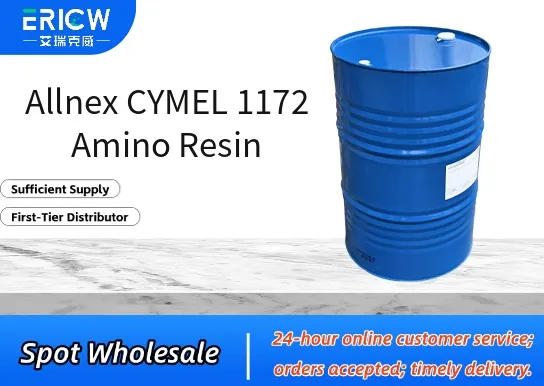
Highly reactive melamine-formaldehyde resin with excellent cure speed at low baking temperatures.
Superior compatibility with acrylic, polyester, and alkyd resins in solventborne coating systems.
Delivers exceptional hardness, chemical resistance, and gloss retention in thermoset coatings.
Low formaldehyde emission profile, supporting compliance with stringent environmental and safety regulations.
Excellent storage stability in acidic catalyzed formulations without premature gelation.
Automotive OEM and refinish topcoats requiring high durability and appearance.
Industrial maintenance coatings for metal substrates exposed to harsh environments.
Appliance coatings demanding superior mar resistance and cleanability.
General-purpose coil coatings for pre-painted metal applications.
Can coatings for food and beverage containers where FDA-compliant cured films are required.
| Chemical Type | Melamine-formaldehyde resin |
| Product Form | Liquid |
| Appearance | Clear to slightly hazy, water-white liquid |
| Solvent Content | Proprietary hydrocarbon solvent blend |
| Non-Volatile Content (wt%) | 80–84% |
| Viscosity (25°C, Brookfield RV, spindle #3, 20 rpm) | 1,200–2,000 cP |
| pH (10% solution in water) | 7.5–8.5 |
| Key Features | Low-bake reactivity, high crosslink density, low formaldehyde release |
Q1: What is the primary function of CYMEL 1172 in coating formulations?
A: CYMEL 1172 functions as a highly reactive melamine-formaldehyde crosslinker, designed to enhance hardness, chemical resistance, and thermal stability in thermosetting coatings—particularly in high-performance industrial and automotive topcoats.
Q2: Is CYMEL 1172 compatible with hydroxyl-functional acrylic or polyester resins?
A: Yes, CYMEL 1172 exhibits excellent compatibility and reactivity with common hydroxyl-functional binder resins, including acrylics and polyesters, enabling efficient curing at moderate bake temperatures (typically 120–160 °C).
Q3: Does CYMEL 1172 require an acid catalyst for effective cure?
A: While CYMEL 1172 can undergo self-catalyzed reaction at elevated temperatures, optimal cure kinetics and film properties are typically achieved with a small amount of a suitable acid catalyst—such as p-toluenesulfonic acid (p-TSA) or blocked acid alternatives—added according to formulation needs.
Q4: How should CYMEL 1172 be stored to maintain stability?
A: Store in tightly sealed containers in a cool, dry, and well-ventilated area, away from strong acids, bases, and excessive moisture. Prolonged exposure to high humidity or temperature may affect shelf life and reactivity.
Contact With Us:
E-mail: wangxingqiang@ericwchem.com
Have a Questions? Call Us:
Add:
Building A1, Jiete Industrial Park, Huangpu District, Guangzhou City, Guangdong Province, China