English
 Español
 tiếng việt
 русский
Highly selective for low-temperature catalytic dechlorination of chlorinated hydrocarbons.
Thermally stable solid catalyst with extended service life under continuous operation.
Non-pyrophoric and inherently safe to handle, store, and transport.
Low metal leaching profile, minimizing downstream contamination in sensitive processes.
Designed for fixed-bed reactor configurations with excellent pressure drop characteristics.
Removal of residual chlorinated impurities from pharmaceutical intermediates.
Purification of electronic-grade solvents used in semiconductor manufacturing.
Treatment of chlorinated by-products in fine chemical synthesis streams.
Dechlorination of effluent streams prior to biological wastewater treatment.
Clean-up of recycled process solvents in agrochemical production.
| Chemical Type | Supported palladium-copper bimetallic catalyst on high-surface-area activated carbon |
| Product Form | Granular solid |
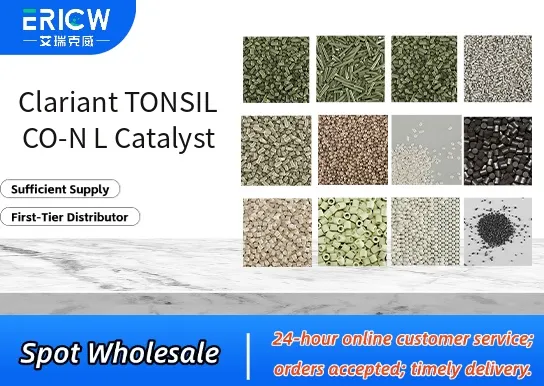
| Appearance | Black granules, free-flowing |
| Primary Applications | Catalytic hydrodechlorination (HDC) at ambient to moderate temperatures (20–80 °C) |
| Key Features | Chlorine-selective, low hydrogen consumption, no acid generation |
| Benefits | Reduces formation of hazardous chlorinated residues; compatible with stainless-steel equipment |
| Storage Conditions | Store in original sealed packaging at room temperature, away from moisture and oxidizing agents |
| Handling Precautions | Use in well-ventilated areas; avoid inhalation of dust; refer to SDS for full safety guidance |
Q1: What is the primary function of TONSIL CO-N L in polymer processing?
A: TONSIL CO-N L is a high-performance clay-based catalyst designed to promote controlled crosslinking and improve thermal stability in silicone elastomers and certain thermoset systems. It supports efficient condensation curing while helping to minimize post-cure shrinkage and enhance mechanical consistency.
Q2: Is TONSIL CO-N L compatible with platinum-catalyzed addition-cure silicones?
A: No — TONSIL CO-N L is specifically formulated for condensation-cure (e.g., acetoxy or oxime) silicone systems. It is not intended for use in platinum-catalyzed addition-cure formulations, where it may interfere with catalytic activity or cause premature gelation.
Q3: How should TONSIL CO-N L be incorporated into a formulation?
A: It is typically added during the mixing stage under moderate shear, after base polymer and fillers are homogenized. Pre-dispersion in a portion of the polymer or solvent may improve uniformity. Dosage depends on formulation requirements but generally ranges from 0.1% to 2% by weight relative to the total batch.
Q4: Does TONSIL CO-N L require special storage conditions?
A: Yes — store in a cool, dry place in original sealed packaging to prevent moisture uptake. Prolonged exposure to ambient humidity may affect reactivity and dispersion behavior. Avoid freezing and direct sunlight.
Contact With Us:
E-mail: wangxingqiang@ericwchem.com
Have a Questions? Call Us:
Add:
Building A1, Jiete Industrial Park, Huangpu District, Guangzhou City, Guangdong Province, China