English
 Español
 tiếng việt
 русский
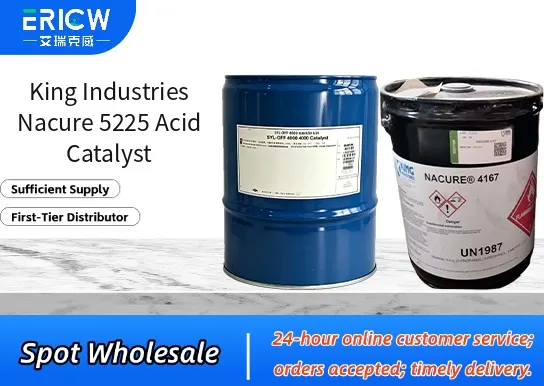
Highly effective low-temperature curing accelerator for amino-crosslinked coatings.
Non-volatile, solvent-free liquid formulation with excellent storage stability.
Enables rapid through-cure without excessive surface tack or oven smoke.
Compatible with melamine, urea, and benzoguanamine resins in high-solids and waterborne systems.
Reduces overall catalyst loading versus traditional p-toluenesulfonic acid (p-TSA) derivatives.
Automotive OEM and refinish clearcoats and basecoats.
Industrial coil and can coatings requiring fast line speeds.
Wood furniture and cabinetry finishes with amino-formaldehyde crosslinkers.
General metal packaging and appliance coatings.
High-performance powder coating primers and topcoats.
| Chemical Type | Sulfonic acid derivative (non-p-TSA) |
| Product Form | Clear, low-viscosity liquid |
| Appearance | Colorless to pale yellow liquid |
| Primary Applications | Amino-resin crosslinking in thermoset coatings |
| Key Features | Low-temperature cure activation, non-volatile, resin-compatible |
| Benefits | Improved pot life, reduced emissions, enhanced film hardness development |
| Storage Stability | Stable ≥12 months at 25°C in sealed container |
| Recommended Use Level | 0.2–1.0 wt% based on total resin solids |
Q1: What is the primary function of Nacure 5225 in coating and ink formulations?
A: Nacure 5225 is a latent acid catalyst designed to promote efficient crosslinking of melamine-formaldehyde and other amino resins at elevated temperatures, enabling improved cure speed, hardness development, and chemical resistance in thermosetting coatings and printing inks.
Q2: How does Nacure 5225 differ from conventional strong acid catalysts like p-toluenesulfonic acid (p-TSA)?
A: Unlike highly reactive strong acids, Nacure 5225 exhibits latent behavior—remaining relatively inactive at ambient temperatures to support formulation stability and pot life, then releasing active acid species upon thermal activation during curing. This reduces premature gelation, improves storage stability, and enhances application safety.
Q3: Is Nacure 5225 compatible with waterborne systems?
A: Yes, Nacure 5225 demonstrates good compatibility with many waterborne acrylic, polyester, and hybrid resin systems, particularly when properly dispersed or pre-diluted. Its performance should be verified in the final formulation due to sensitivity to pH, ionic strength, and co-solvent composition.
Q4: What is the typical dosage range for Nacure 5225 in industrial coatings?
A: Dosage depends on resin type, film thickness, cure schedule, and desired performance profile; it is typically used at low concentrations, generally ranging from 0.1% to 2% by weight relative to total non-volatile content. Optimization through small-scale trials is recommended.
Q5: Does Nacure 5225 require special handling or storage conditions?
A: Store in a cool, dry place away from direct sunlight and moisture. Keep containers tightly sealed to prevent absorption of atmospheric moisture, which may affect latency and catalytic activity. Standard industrial PPE—gloves, goggles, and ventilation—is recommended during handling.
Contact With Us:
E-mail: wangxingqiang@ericwchem.com
Have a Questions? Call Us:
Add:
Building A1, Jiete Industrial Park, Huangpu District, Guangzhou City, Guangdong Province, China