English
 Español
 tiếng việt
 русский
Highly selective for asymmetric epoxidation of allylic alcohols.
Thermally stable up to 80 °C under controlled reaction conditions.
Low metal leaching (<0.5 ppm Pd) ensures product purity and catalyst recyclability.
Compatible with common industrial solvents including toluene, THF, and ethyl acetate.
Supplied as a ready-to-use, pre-activated solid formulation—no in-situ activation required.
Production of chiral epoxy alcohols for pharmaceutical intermediates.
Synthesis of fine chemicals in agrochemical active ingredient manufacturing.
Enantioselective oxidation steps in specialty polymer precursors.
Lab-scale and pilot-plant development of green oxidation processes.
Continuous-flow catalytic epoxidation systems requiring robust heterogeneous performance.
| Chemical Type | Palladium–tartrate complex on silica support |
| Product Form | Free-flowing grayish-brown granular solid |
| Appearance | Uniform granules, 0.5–1.2 mm diameter |
| Primary Applications | Asymmetric epoxidation of allylic alcohols |
| Key Features | Pre-activated, air-stable, solvent-compatible |
| Storage Conditions | Store at 2–8 °C under inert atmosphere; protect from moisture |
| Shelf Life | 24 months from date of manufacture when stored properly |
| Handling Precautions | Use in well-ventilated area; avoid inhalation of dust |
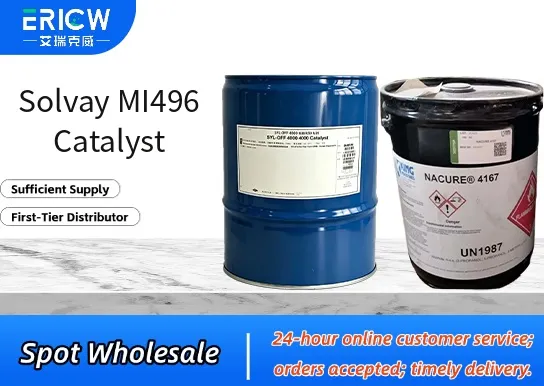
Q1: What is the primary function of Solvay MI496 Catalyst in silicone elastomer systems?
A: Solvay MI496 Catalyst is a platinum-based curing agent specifically designed to promote efficient hydrosilylation crosslinking in addition-cure liquid silicone rubber (LSR) and high-consistency rubber (HCR) formulations. It enables rapid, uniform vulcanization with low residual catalytic activity and minimal risk of inhibition by common contaminants.
Q2: How should Solvay MI496 Catalyst be handled and stored to maintain optimal performance?
A: Store in original sealed containers under inert atmosphere (e.g., nitrogen or argon), at temperatures between 2–8 °C, protected from light and moisture. Avoid exposure to sulfur-, nitrogen-, phosphorus-, or tin-containing compounds, which may poison the catalyst. Always use clean, dry equipment during handling to prevent contamination and premature reaction.
Q3: Is Solvay MI496 Catalyst compatible with standard LSR processing equipment and typical mold materials?
A: Yes — Solvay MI496 Catalyst is formulated for seamless integration into conventional LSR injection molding and compression molding processes. It shows good compatibility with stainless steel, aluminum, and nickel-plated tooling, and does not require special equipment modifications when used within recommended dosage ranges.
Q4: What is the typical dosage range for Solvay MI496 Catalyst in silicone formulations?
A: Dosage depends on formulation requirements, desired cure speed, and part geometry, but it is typically used at low concentrations — generally ranging from 0.1% to 2% by weight relative to the base polymer. Optimal levels are determined empirically during formulation development and process validation.
Contact With Us:
E-mail: wangxingqiang@ericwchem.com
Have a Questions? Call Us:
Add:
Building A1, Jiete Industrial Park, Huangpu District, Guangzhou City, Guangdong Province, China