English
 Español
 tiếng việt
 русский
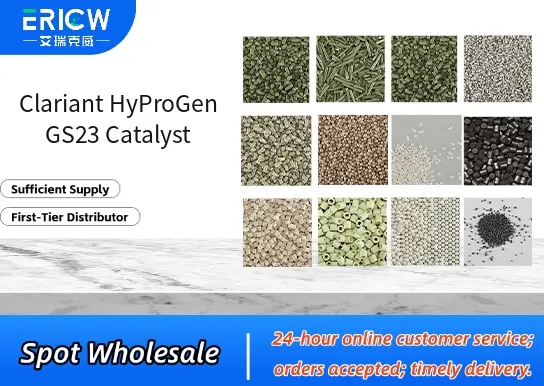
Highly selective hydrogenation catalyst for unsaturated aldehydes and esters under mild conditions.
Thermally stable nickel-based formulation with optimized support for extended service life.
Low dust generation and excellent flowability for safe, consistent handling in continuous processes.
Pre-sulfided activation state enables rapid start-up without on-site sulfidation.
Controlled metal dispersion ensures reproducible performance across production batches.
Hydrogenation of citral to geraniol and nerol in fragrance intermediate synthesis.
Selective reduction of methyl acrylate to propanoic acid derivatives in pharmaceutical intermediates.
Conversion of unsaturated fatty acid methyl esters (FAME) in bio-based lubricant production.
Hydrogenation of cinnamaldehyde to hydrocinnamaldehyde for fine chemical manufacturing.
| Chemical Type | Nickel-molybdenum sulfide on silica-alumina support |
| Product Form | Extruded cylindrical pellets (1.8–2.2 mm diameter) |
| Appearance | Black, free-flowing granular solid |
| Primary Applications | Selective liquid-phase hydrogenation of α,β-unsaturated carbonyl compounds |
| Key Features | Pre-activated, sulfur-stabilized, low leaching, high chemoselectivity |
| Benefits | Reduced catalyst inventory, shorter cycle times, lower H₂ consumption |
| Storage Conditions | Store under inert atmosphere (N₂) at ambient temperature; protect from moisture |
Q1: What is the primary function of HyProGen GS23 in polymer processing?
A: HyProGen GS23 is a heterogeneous hydrogenation catalyst designed to selectively saturate unsaturated bonds—particularly carbon–carbon double bonds—in thermoplastic polymers and elastomers during melt-phase processing. It enables controlled molecular stabilization without significant chain scission or crosslinking under typical extrusion or compounding conditions.
Q2: Is HyProGen GS23 compatible with common engineering thermoplastics such as polyolefins and styrenics?
A: Yes, HyProGen GS23 demonstrates broad compatibility with polyolefins (e.g., PP, HDPE, LLDPE), hydrogenated styrenic block copolymers (SEBS), and other saturated/unsaturated polymer blends. Its supported metal formulation minimizes adverse interactions with stabilizers and fillers commonly used in these systems.
Q3: How is HyProGen GS23 typically incorporated into polymer formulations?
A: It is generally introduced via dry blending or masterbatch dilution prior to melt processing. Due to its heterogeneous nature, uniform dispersion is achieved during standard extrusion or injection molding operations. Dosage depends on formulation requirements but typically ranges from 0.1% to 2% by weight relative to the polymer matrix.
Q4: Does HyProGen GS23 require special handling or storage conditions?
A: As a pyrophoric-free, air-stable solid catalyst, HyProGen GS23 does not require inert-atmosphere handling under normal factory conditions. However, it should be stored in a cool, dry place away from strong oxidizing agents and direct sunlight to maintain optimal activity over time.
Contact With Us:
E-mail: wangxingqiang@ericwchem.com
Have a Questions? Call Us:
Add:
Building A1, Jiete Industrial Park, Huangpu District, Guangzhou City, Guangdong Province, China