English
 Español
 tiếng việt
 русский
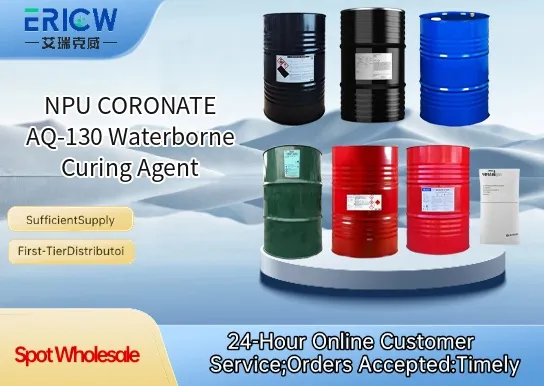
Low-VOC, water-dispersible polyisocyanate curing agent compliant with global environmental regulations.
Excellent hydrolytic stability for extended pot life in aqueous coating formulations.
Enables fast ambient-temperature crosslinking with acrylic, polyester, or hybrid waterborne resins.
Delivers superior hardness, chemical resistance, and mar resistance in cured films.
Compatible with standard industrial spray and roller application equipment without reformulation.
Waterborne industrial maintenance coatings for metal substrates.
High-performance architectural coatings requiring enhanced durability and low odor.
Automotive refinish clearcoats and basecoats with stringent VOC compliance.
Wood finishing systems where low emissions and rapid dry-through are critical.
Plastic coatings for interior automotive parts and consumer electronics housings.
| Chemical Type | Aliphatic polyisocyanate (HDI-based) |
| Product Form | Aqueous dispersion |
| Appearance | Clear to slightly hazy, colorless to pale yellow liquid |
| NCO Content (wt%) | 8.5 – 9.5% |
| pH (10% in DI water) | 7.0 – 8.5 |
| Viscosity (25°C, mPa·s) | 200 – 600 |
| Solids Content (wt%) | 35 – 40% |
| Storage Stability (25°C) | ≥6 months in sealed container |
Q1: What types of waterborne resins is NPU CORONATE AQ-130 compatible with?
A: NPU CORONATE AQ-130 is specifically designed for use with aqueous polyurethane dispersions (PUDs), acrylic emulsions, and hybrid acrylic-PUD systems. It demonstrates good compatibility and reactivity across a broad pH range and is commonly employed in two-component waterborne coatings requiring enhanced crosslink density and film performance.
Q2: How does AQ-130 compare to traditional solvent-based isocyanate curing agents in terms of pot life and handling?
A: As a waterborne aliphatic polyisocyanate dispersion, AQ-130 offers extended pot life compared to many solvent-based counterparts—typically several hours at ambient conditions when properly formulated—due to its stabilized dispersion and reduced sensitivity to ambient moisture during mixing. It eliminates the need for organic solvents during blending and reduces VOC emissions significantly.
Q3: What are the recommended storage conditions and shelf life for AQ-130?
A: Store AQ-130 in tightly sealed original containers at temperatures between 5 °C and 30 °C, away from direct sunlight and freezing conditions. Under these conditions, the product typically maintains stability and performance for up to 12 months from the date of manufacture. Avoid prolonged exposure to high humidity or temperature fluctuations during storage.
Q4: Does AQ-130 require catalysts or co-solvents to achieve full cure?
A: AQ-130 is formulated to react efficiently with common waterborne resins without mandatory catalyst addition. However, depending on cure speed requirements and film thickness, small amounts of tertiary amine catalysts or low-VOC co-solvents may be used to fine-tune reactivity and film formation—always subject to formulation testing and compatibility verification.
Contact With Us:
E-mail: wangxingqiang@ericwchem.com
Have a Questions? Call Us:
Add:
Building A1, Jiete Industrial Park, Huangpu District, Guangzhou City, Guangdong Province, China