English
 Español
 tiếng việt
 русский
Highly selective for propylene oxide (PO) production via hydrogen peroxide to propylene (HPPO) process.
Exceptional long-term stability under industrial-scale continuous operation conditions.
Low titanium leaching ensures minimal downstream catalyst poisoning and product contamination.
Optimized pore structure enhances mass transfer efficiency and reaction kinetics.
Designed for seamless integration into existing HPPO reactor systems without major retrofitting.
Propylene oxide (PO) manufacturing via the hydrogen peroxide to propylene (HPPO) process.
Co-production of PO and propylene glycol monomethyl ether (PGME) in integrated units.
High-purity PO synthesis for polyurethane precursor applications.
Sustainable chemical manufacturing requiring low environmental impact and high atom economy.
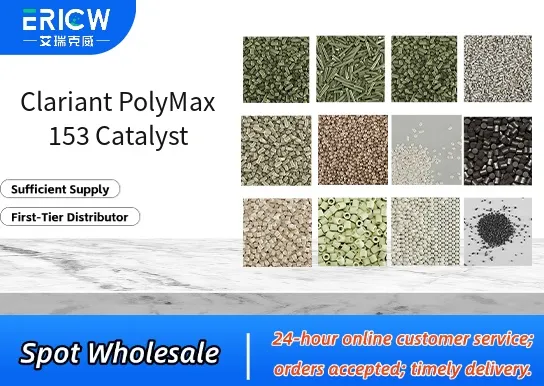
| Chemical Type | Titanium silicalite-1 (TS-1) based zeolitic catalyst |
| Product Form | Free-flowing granular solid |
| Appearance | Off-white to light gray spherical pellets |
| Primary Applications | Hydrogen peroxide to propylene (HPPO) oxidation |
| Key Features | High Ti dispersion, hydrophobic surface, narrow particle size distribution |
| Benefits | Reduced H2O2 decomposition, extended cycle life, consistent PO selectivity >95% |
| Storage Conditions | Dry, cool, well-ventilated environment; avoid moisture exposure |
| Handling Precautions | Use in accordance with standard industrial catalyst safety protocols (no known acute toxicity) |
Q1: What is the primary function of PolyMax 153 in polyolefin processing?
A: PolyMax 153 is a highly active metallocene-based catalyst designed to enable precise control over polymer microstructure—particularly for producing linear low-density polyethylene (LLDPE) and ethylene–α-olefin copolymers with narrow molecular weight distribution and uniform comonomer incorporation.
Q2: Is PolyMax 153 compatible with conventional Ziegler–Natta or Phillips catalyst systems?
A: No—PolyMax 153 is a single-site metallocene catalyst and is not intended for direct blending or co-use with multi-site heterogeneous catalysts. Its performance relies on controlled activation conditions and dedicated reactor configurations, typically in solution or slurry processes optimized for metallocene chemistry.
Q3: How is PolyMax 153 typically handled and dosed in industrial production?
A: It is supplied as a stable, free-flowing solid or as a pre-dispersed slurry in inert hydrocarbon media. Handling requires inert atmosphere (e.g., nitrogen or argon) to maintain activity; dosage is generally adjusted within the range of 0.1% to 2% by weight relative to the main catalyst support or carrier system, depending on reactor type and desired polymer kinetics.
Q4: Does PolyMax 153 require a separate activator or co-catalyst?
A: Yes—activation typically requires an organoaluminum compound (e.g., triethylaluminum or modified alkylaluminums) and/or an ionic activator such as methylaluminoxane (MAO) or a non-coordinating anion (NCA) system. The choice and ratio depend on process configuration and target polymer properties.
Contact With Us:
E-mail: wangxingqiang@ericwchem.com
Have a Questions? Call Us:
Add:
Building A1, Jiete Industrial Park, Huangpu District, Guangzhou City, Guangdong Province, China