English
 Español
 tiếng việt
 русский
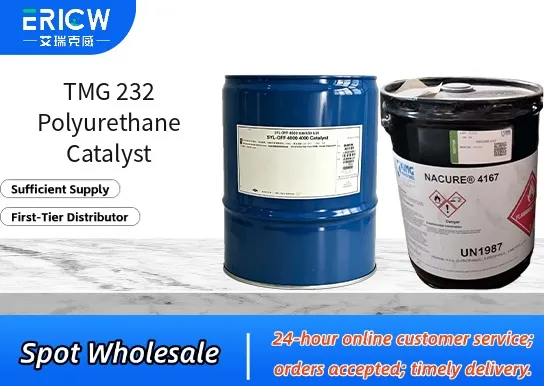
Highly selective tertiary amine catalyst optimized for polyol-isocyanate reaction kinetics.
Low volatility and minimal odor, supporting safer handling and improved workplace air quality.
Excellent compatibility with common polyols, isocyanates, and formulation additives.
Enables balanced reactivity—promotes gelation without excessive blowing—ideal for structural foam and elastomer systems.
Stable under ambient storage conditions; non-corrosive to standard processing equipment.
Flexible molded polyurethane foams for automotive seating and interior components.
Slabstock flexible foams used in bedding and furniture manufacturing.
Reaction injection molding (RIM) and reinforced RIM (RRIM) elastomers.
Microcellular polyurethane sealants and gasketing compounds.
High-resilience (HR) foam formulations requiring precise cure profile control.
| Chemical Type | Tertiary amine |
| Product Form | Liquid |
| Appearance | Clear, light amber liquid |
| Density (25°C) | 0.92–0.94 g/cm³ |
| Refractive Index (25°C) | 1.470–1.480 |
| pH (1% aqueous solution) | 10.5–11.2 |
| Solubility | Miscible with common polyols and solvents including DMF, THF, and glycols |
| Storage Stability | ≥24 months in sealed container at 5–30°C |
Q1: What is the primary function of TMG 232 in polyurethane systems?
A: TMG 232 is a highly selective tertiary amine catalyst that primarily promotes the urethane reaction (isocyanate–polyol coupling), enabling efficient gelation and improved cell structure control in flexible and semi-rigid foams, as well as certain CASE applications.
Q2: How does TMG 232 compare to traditional amine catalysts like DABCO 33-LV or TEDA?
A: Unlike many conventional cyclic amines, TMG 232 offers lower volatility, reduced odor, and enhanced compatibility with water-blown and low-emission formulations. It also provides a more balanced reactivity profile—supporting both cream time and rise without excessive post-rise shrinkage or surface defects.
Q3: Is TMG 232 suitable for use in automotive interior foam applications?
A: Yes—TMG 232 is widely selected for automotive seating and trim foams due to its low volatility and favorable fogging performance, supporting compliance with OEM requirements for interior air quality and emissions control.
Q4: What is the typical dosage range for TMG 232 in flexible slabstock foam formulations?
A: Dosage depends on formulation requirements and desired processing window, but it is typically used at low concentrations—generally ranging from 0.1% to 2% by weight relative to the total polyol blend—and is often blended with other catalysts to fine-tune cream, gel, and tack-free times.
Q5: Can TMG 232 be used in moisture-cured or one-component polyurethane sealants?
A: While TMG 232 is primarily optimized for two-component polyurethane foam and elastomer systems, it may be considered in select one-component formulations where controlled cure kinetics and low-temperature activity are needed—however, compatibility and shelf-life stability must be validated experimentally for each specific system.
Contact With Us:
E-mail: wangxingqiang@ericwchem.com
Have a Questions? Call Us:
Add:
Building A1, Jiete Industrial Park, Huangpu District, Guangzhou City, Guangdong Province, China