English
 Español
 tiếng việt
 русский
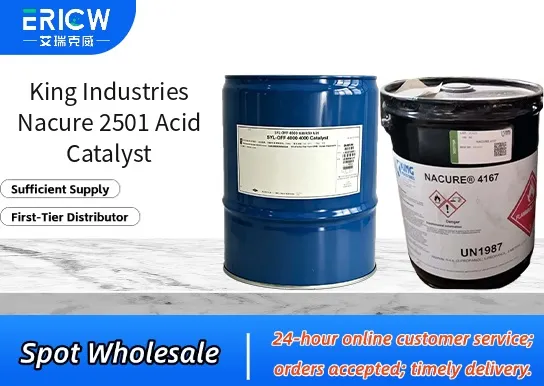
Highly effective low-temperature curing catalyst for alkyd, polyester, and acrylic resin systems.
Non-volatile, solvent-free liquid formulation with excellent storage stability.
Enables rapid through-cure without excessive surface tack or wrinkling.
Compatible with both cobalt-free and cobalt-containing formulations for regulatory flexibility.
Reduces oven dwell time and energy consumption in industrial coil and can coating lines.
Industrial coil coatings for architectural and appliance substrates.
Automotive OEM and refinish clearcoats requiring fast ambient or forced-dry cure.
General metal packaging coatings (e.g., food cans, aerosol containers).
High-solids and low-VOC industrial maintenance coatings.
Wood finishing systems based on air-drying alkyds and modified polyesters.
| Chemical Type | Organic acid derivative (sulfonic acid-based) |
| Product Form | Clear, amber liquid |
| Appearance | Homogeneous, free-flowing liquid |
| Primary Applications | Catalyst for oxidative crosslinking of alkyd, polyester, and acrylic resins |
| Key Features | Low-temperature cure activation, non-volatile, cobalt-free alternative |
| Benefits | Improved pot life control, reduced VOC emissions, enhanced film hardness development |
| Recommended Use Level | 0.2–0.8% by weight of total formulation (non-volatile basis) |
| Storage Conditions | Store in original sealed container at 15–25°C; protect from moisture and direct sunlight |
Q1: What is the primary function of Nacure 2501 in coating and ink formulations?
A: Nacure 2501 is a latent acid catalyst designed to promote efficient crosslinking of melamine-formaldehyde and other amine-based resins at elevated temperatures. It remains inactive at ambient conditions, enabling extended pot life and improved formulation stability prior to cure.
Q2: Is Nacure 2501 compatible with waterborne systems?
A: Yes, Nacure 2501 exhibits good compatibility with many waterborne acrylic, polyester, and hybrid resin systems. Its hydrophobic character may require gentle agitation or pre-dilution in a co-solvent for optimal dispersion, but it does not typically cause destabilization when properly incorporated.
Q3: How does Nacure 2501 compare to traditional p-toluenesulfonic acid (p-TSA) in terms of handling and safety?
A: Unlike highly corrosive and volatile liquid catalysts such as p-TSA, Nacure 2501 is supplied as a free-flowing solid with significantly lower volatility and reduced skin/eye irritation potential. This contributes to safer handling, improved workplace hygiene, and easier storage without special containment requirements.
Q4: What is the typical dosage range for Nacure 2501 in thermoset coatings?
A: Dosage depends on resin type, film thickness, and cure schedule, but Nacure 2501 is generally used at low concentrations—typically ranging from 0.1% to 2% by weight relative to total non-volatile content. Optimization through small-scale cure testing is recommended for each specific formulation.
Contact With Us:
E-mail: wangxingqiang@ericwchem.com
Have a Questions? Call Us:
Add:
Building A1, Jiete Industrial Park, Huangpu District, Guangzhou City, Guangdong Province, China