English
 Español
 tiếng việt
 русский
Highly selective for propylene oxide (PO) production via the hydrogen peroxide to propylene epoxidation (HPPO) process.
Exceptional long-term stability under industrial operating conditions, minimizing catalyst replacement frequency.
Low titanium leaching ensures consistent product purity and reduced downstream purification burden.
Optimized pore structure enhances mass transfer efficiency and improves overall reactor productivity.
Designed for seamless integration into existing HPPO infrastructure with minimal process modification.
Propylene oxide (PO) manufacturing via the hydrogen peroxide to propylene epoxidation (HPPO) process.
Co-production of PO and propylene glycol monomethyl ether (PGME) in integrated petrochemical facilities.
High-purity PO synthesis for polyether polyols used in flexible polyurethane foams.
On-purpose PO supply chains serving specialty chemical and pharmaceutical intermediates.
Eco-efficient oxidation processes requiring low environmental footprint and high atom economy.
| Chemical Type | Titanium silicalite-1 (TS-1) based heterogeneous catalyst |
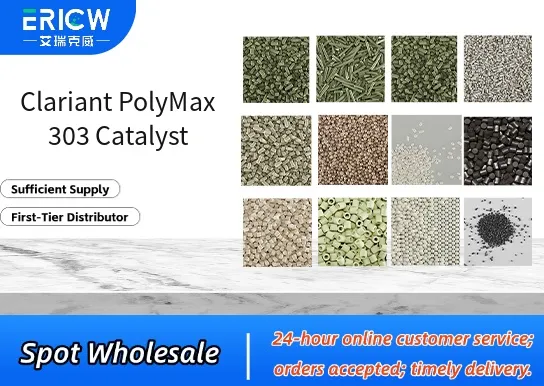
| Product Form | Free-flowing granular solid |
| Appearance | Off-white to light gray cylindrical extrudates |
| Primary Applications | Hydrogen peroxide-based propylene epoxidation (HPPO) |
| Key Features | High Ti dispersion, hydrophobic surface, narrow pore size distribution |
| Benefits | Improved PO selectivity (>99%), reduced by-product formation, extended catalyst cycle life |
| Storage Conditions | Store in dry, cool, well-ventilated area; protect from moisture and direct sunlight |
| Handling Precautions | Use appropriate PPE; avoid inhalation of dust; non-hazardous per GHS classification |
Q1: What is the primary function of PolyMax 303 in polymer processing?
A: PolyMax 303 is a high-performance catalyst designed to accelerate crosslinking reactions—particularly in peroxide-cured elastomers and thermosetting polyolefin compounds—enhancing cure efficiency, scorch safety, and final mechanical properties without compromising process stability.
Q2: Is PolyMax 303 compatible with common peroxide initiators such as DCP or DBPH?
A: Yes, PolyMax 303 demonstrates broad compatibility with standard organic peroxides including dicumyl peroxide (DCP) and di-tert-butyl peroxide (DBPH), and is formulated to synergistically improve decomposition kinetics and network uniformity in demanding curing environments.
Q3: How should PolyMax 303 be incorporated into a compound?
A: It is typically added during the masterbatch or final mixing stage using standard internal mixers or twin-screw extruders. Good dispersion is achieved under typical shear conditions used for elastomer and thermoplastic compounding; pre-dilution in a carrier polymer or oil may be considered for highly sensitive formulations.
Q4: Does PolyMax 303 affect the thermal stability or aging behavior of cured products?
A: When used within recommended dosage ranges, PolyMax 303 contributes to more homogeneous crosslink networks, which generally supports improved long-term thermal stability and resistance to compression set—especially in dynamic sealing applications—but final performance depends on the full formulation and post-cure conditions.
Q5: What packaging options are available for PolyMax 303?
A: PolyMax 303 is supplied in sealed, moisture-resistant containers—including HDPE drums and multi-wall paper bags with inner liners—to preserve catalytic activity and ensure safe handling during storage and processing.
Contact With Us:
E-mail: wangxingqiang@ericwchem.com
Have a Questions? Call Us:
Add:
Building A1, Jiete Industrial Park, Huangpu District, Guangzhou City, Guangdong Province, China