English
 Español
 tiếng việt
 русский
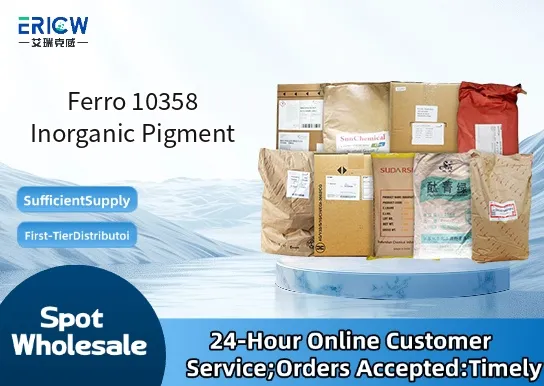
High thermal stability suitable for processing temperatures up to 1200°C.
Excellent chemical resistance to acids, alkalis, and solvents in demanding industrial environments.
Consistent batch-to-batch color reproducibility certified under ISO 9001 manufacturing controls.
Low heavy metal content compliant with EU REACH and US EPA regulatory requirements.
Optimized particle size distribution for enhanced dispersion and opacity in ceramic glazes and vitreous coatings.
Ceramic tile glazes for architectural and sanitaryware applications.
Vitreous enamel coatings on steel and cast iron substrates.
Colorants in refractory mortars and high-temperature furnace linings.
Pigmentation of frits and glass batches for decorative and functional glassware.
Stable coloring agent in porcelain stoneware bodies and engobes.
| Chemical Type | Mixed-metal oxide (chromium-iron spinel) |
| Product Form | Free-flowing dry powder |
| Appearance | Dark green to black granular powder |
| Primary Applications | Ceramic glazes, vitreous enamels, refractories |
| Key Features | Thermal stability, acid/alkali resistance, non-volatile |
| Benefits | Color retention after firing, low volatility, minimal sintering effect |
| Storage Conditions | Store in cool, dry location; protect from moisture and contamination |
| Regulatory Compliance | REACH SVHC-free, RoHS-compliant, no added cadmium or lead |
Q1: What is the primary chemical composition of Ferro 10358?
A: Ferro 10358 is a mixed-metal oxide pigment, formulated with iron and chromium as key constituents, providing inherent thermal and chemical stability typical of high-performance inorganic colorants.
Q2: Is Ferro 10358 suitable for use in food-contact plastics?
A: Yes — Ferro 10358 is designed for applications requiring regulatory compliance in food-contact polymers, including polyolefins and engineering resins, subject to final formulation validation and adherence to applicable regional food-contact legislation.
Q3: How does Ferro 10358 perform under high-temperature processing conditions?
A: This pigment exhibits excellent thermal stability and retains its color integrity during standard polymer processing, including injection molding and extrusion at temperatures commonly exceeding 280 °C.
Q4: Can Ferro 10358 be used in both crystalline and amorphous thermoplastics?
A: Yes — it demonstrates broad compatibility across major thermoplastic families, including PP, PE, PS, ABS, and PC, with consistent dispersion behavior and minimal impact on mechanical properties when properly compounded.
Q5: What is the recommended method for incorporating Ferro 10358 into polymer systems?
A: It is typically supplied as a masterbatch or dry blend concentrate and is best incorporated via twin-screw extrusion or high-shear compounding to ensure uniform dispersion; dosage depends on formulation requirements but generally ranges from 0.1% to 2% by weight.
Contact With Us:
E-mail: wangxingqiang@ericwchem.com
Have a Questions? Call Us:
Add:
Building A1, Jiete Industrial Park, Huangpu District, Guangzhou City, Guangdong Province, China