English
 Español
 tiếng việt
 русский
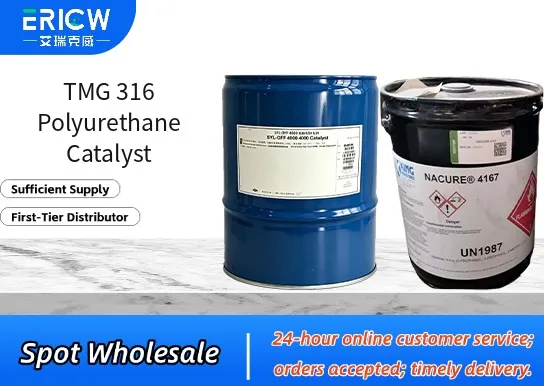
Highly selective tertiary amine catalyst optimized for polyurethane flexible slabstock foam production.
Excellent balance of cream, gel, and tack-free times to support high-speed continuous manufacturing.
Low volatility and minimal odor—reduces workplace exposure and improves operator safety.
Good compatibility with common polyols, isocyanates, and auxiliary additives in PU systems.
Stable performance across varying ambient humidity and raw material batch fluctuations.
Flexible molded polyurethane foams for automotive seating and interior components.
Continuous slabstock foam production for bedding and furniture applications.
High-resiliency (HR) foam formulations requiring precise reactivity control.
Water-blown and low-emission PU foam systems compliant with VOC regulations.
Hybrid systems incorporating bio-based polyols or recycled content.
| Chemical Type | Tertiary amine |
| Product Form | Liquid |
| Appearance | Clear, pale yellow liquid |
| Primary Applications | Flexible polyurethane foam (slabstock & molded) |
| Key Features | Reactivity balancing, low volatility, formulation stability |
| Benefits | Improved processing window, reduced emissions, consistent foam quality |
| Storage Conditions | Store in original sealed container at 15–25°C, protect from moisture |
| Shelf Life | 24 months from date of manufacture under recommended conditions |
Q1: What is the primary function of TMG 316 in polyurethane systems?
A: TMG 316 is a tertiary amine-based catalyst designed to accelerate the urethane reaction (isocyanate–polyol coupling), promoting efficient gelation and improving processing control in flexible and rigid foam, coatings, and elastomer formulations.
Q2: Is TMG 316 compatible with moisture-sensitive or low-emission polyurethane systems?
A: Yes — TMG 316 exhibits low volatility and minimal odor compared to many conventional amine catalysts, making it suitable for formulations targeting reduced VOC emissions and improved workplace handling. It does not significantly promote the competing isocyanate–water reaction under typical processing conditions.
Q3: How should TMG 316 be incorporated into a polyurethane formulation?
A: TMG 316 is typically added to the polyol blend prior to mixing with isocyanate. It is fully miscible with common polyols and processing aids, and requires no special handling beyond standard industrial chemical safety practices. Dosage depends on formulation requirements but generally ranges from 0.1% to 2% by weight relative to the polyol component.
Q4: Can TMG 316 be used in combination with other catalysts?
A: Yes — TMG 316 is commonly used synergistically with tin-based catalysts (e.g., dibutyltin dilaurate) or other amine catalysts to fine-tune cream, gel, and tack-free times. Compatibility testing is recommended for new multi-catalyst combinations to ensure predictable reactivity balance.
Contact With Us:
E-mail: wangxingqiang@ericwchem.com
Have a Questions? Call Us:
Add:
Building A1, Jiete Industrial Park, Huangpu District, Guangzhou City, Guangdong Province, China