English
 Español
 tiếng việt
 русский
High-intensity fluorescence under UV and daylight illumination.
Excellent thermal stability up to 220°C for processing in extrusion and injection molding.
Good dispersion performance in both polar and non-polar polymer matrices.
Low migration tendency, ensuring color fidelity in flexible packaging films.
Compliant with REACH and RoHS directives for restricted substances.
Security printing in banknotes, passports, and tax stamps.
High-visibility safety signage and personal protective equipment (PPE).
Fluorescent inks for textile screen printing and digital textile applications.
UV-responsive masterbatches for polyethylene (PE), polypropylene (PP), and PET films.
Specialty coatings for advertising displays and event branding materials.
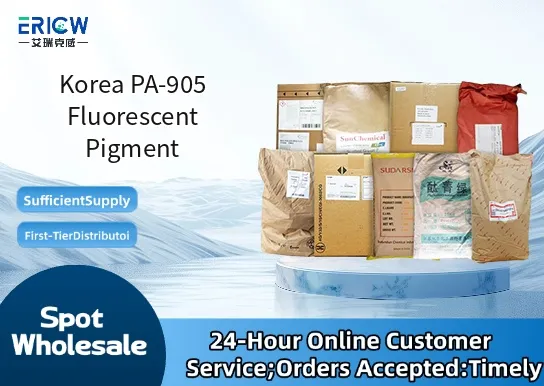
| Chemical Type | Disazo-based fluorescent organic pigment |
| Product Form | Free-flowing fine powder |
| Appearance | Bright yellow-green powder |
| Primary Applications | Polymer masterbatches, solvent-based inks, water-based coatings |
| Key Features | UV-stable, non-bleeding, low dust generation |
| Benefits | Consistent batch-to-batch color strength and fluorescence intensity |
| Storage Conditions | Keep in cool, dry place below 30°C; protect from direct sunlight |
| Shelf Life | 24 months from date of manufacture when stored properly |
Q1: What types of resin systems is Korea PA-905 compatible with?
A: Korea PA-905 is formulated for compatibility with common thermoplastic resins including polyethylene (PE), polypropylene (PP), polystyrene (PS), and ABS. It demonstrates good thermal stability during standard extrusion and injection molding processes, though performance may vary depending on resin polarity and processing temperature.
Q2: How does PA-905 perform under UV exposure?
A: As a fluorescent pigment, PA-905 exhibits strong visible fluorescence when excited by UV-A radiation (320–400 nm). Its photostability is moderate under indoor conditions but may gradually diminish with prolonged outdoor UV exposure without protective additives or topcoats.
Q3: What is the recommended dosage range for optimal fluorescence intensity?
A: Fluorescence intensity generally increases with dosage, but diminishing returns and potential agglomeration occur at higher loadings. It is typically used at low concentrations—generally ranging from 0.1% to 2% by weight—depending on the base polymer, desired brightness, and processing method.
Q4: Can PA-905 be used in food-contact plastics?
A: Korea PA-905 is not certified for direct food-contact applications. It is intended for general industrial, decorative, and functional plastic coloration where regulatory compliance for food contact is not required. Customers requiring food-safe alternatives should consult our technical team for suitable compliant options.
Contact With Us:
E-mail: wangxingqiang@ericwchem.com
Have a Questions? Call Us:
Add:
Building A1, Jiete Industrial Park, Huangpu District, Guangzhou City, Guangdong Province, China