English
 Español
 tiếng việt
 русский
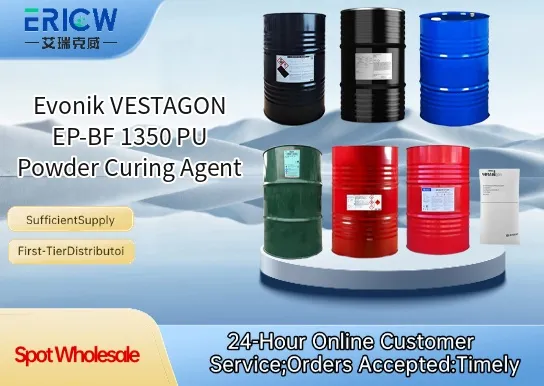
High reactivity with hydroxyl-functional polyester and acrylic resins for fast cure at low temperatures (140–160 °C).
Excellent storage stability as a free-flowing, non-dusting powder with low tendency to agglomerate.
Enables high-gloss, smooth, and defect-free coatings with superior mechanical resistance and chemical durability.
Low volatile organic compound (VOC) content — fully compliant with stringent environmental regulations for powder coatings.
Consistent batch-to-batch performance ensured by Evonik’s controlled manufacturing and rigorous quality control.
Architectural aluminum extrusions for façades, windows, and curtain walls.
Automotive exterior trim and under-hood components requiring thermal and UV resistance.
Appliance housings including refrigerators, washing machines, and ovens.
Office furniture, shelving systems, and metal office partitions.
Outdoor lighting fixtures and street furniture exposed to weathering and corrosion.
| Chemical Type | Bis(4-isocyanatocyclohexyl)methane (H12MDI)-based blocked polyisocyanate |
| Product Form | Free-flowing crystalline powder |
| Appearance | White to off-white granular solid |
| Primary Applications | Curing agent for hydroxyl-functional polyester and acrylic powder coatings |
| Key Features | Blocked isocyanate; thermally activated; low blocking agent residue |
| Benefits | Enhanced flow, reduced orange peel, excellent edge coverage, and improved pot life |
| Recommended Cure Schedule | 150 °C / 15 min or 160 °C / 10 min (film thickness: 60–80 µm) |
| Storage Conditions | Store in original sealed packaging at ≤25 °C and <60% relative humidity |
Q1: What is the primary function of VESTAGON EP-BF 1350 in polyurethane powder coatings?
A: VESTAGON EP-BF 1350 is a blocked polyisocyanate curing agent specifically designed for thermosetting polyurethane (PU) powder coatings. It enables crosslinking with polyester resins upon thermal activation, delivering excellent gloss retention, mechanical durability, and chemical resistance in the cured film.
Q2: At what temperature does EP-BF 1350 typically deblock and initiate crosslinking?
A: EP-BF 1350 is formulated for mid-temperature curing applications, with effective deblocking generally occurring between 160 °C and 180 °C. Optimal cure schedules depend on substrate type, film thickness, and oven dwell time — recommended to be validated under actual production conditions.
Q3: Is EP-BF 1350 compatible with standard polyester resins used in architectural and industrial powder coatings?
A: Yes — EP-BF 1350 is engineered for compatibility with conventional hydroxyl-functional saturated polyesters, including both crystalline and amorphous grades. It supports good flow, leveling, and storage stability in formulated powders when properly dispersed and blended.
Q4: How should EP-BF 1350 be incorporated into a powder coating formulation?
A: It is typically dry-blended with the base resin and additives prior to extrusion, or introduced during the melt mixing stage. Dosage depends on formulation requirements but generally ranges from 0.1% to 2% by weight relative to total solid content — precise levels should be determined through lab-scale optimization and performance testing.
Q5: Does EP-BF 1350 require special handling or storage precautions?
A: As a moisture-sensitive blocked isocyanate, EP-BF 1350 should be stored in a cool, dry place under inert atmosphere or sealed packaging to prevent premature deblocking or humidity-induced agglomeration. Avoid prolonged exposure to ambient air during handling and processing.
Contact With Us:
E-mail: wangxingqiang@ericwchem.com
Have a Questions? Call Us:
Add:
Building A1, Jiete Industrial Park, Huangpu District, Guangzhou City, Guangdong Province, China