Features Of Evonik Dynasylan 1411 Diaminosilane Coupling Agent
Dual Amino Reactivity - Features both primary and secondary amino groups for enhanced crosslinking
Self-Catalyzing Hydrolysis - Autocatalytic action simplifies processing without additional catalysts
Excellent Adhesion Promotion - Significantly improves bond strength across diverse materials
Electrical Properties Enhancement - Improves dielectric constant and volume resistivity
Typical Applications Of Evonik Dynasylan 1411 Diaminosilane Coupling Agent
Foundry Resin Systems - Additive for cold-cure phenolic and furan binders in sand casting
Mineral Fiber Insulation - Binder component for phenolic resin adhesives
Silicone Resin Synthesis - Key monomer for amino-functional silicone production
Sealants & Adhesives - Primer and additive for enhanced bonding performance
Protective Coatings - Adhesion promoter for paint and coating formulations
Specifications Of Evonik Dynasylan 1411 Diaminosilane Coupling Agent
| Chemical Name | 2-Aminoethyl-3-aminopropyl-methyldimethoxysilane |
| Functionality | Diamino Silane |
| Appearance | Yellow transparent liquid |
| Odor | Ammonia-like |
| Solubility | Alcohols, Hydrocarbons |
| Hydrolysis pH | 10-11 (self-catalyzed) |
| Reactive Groups | Amino, Methoxy |
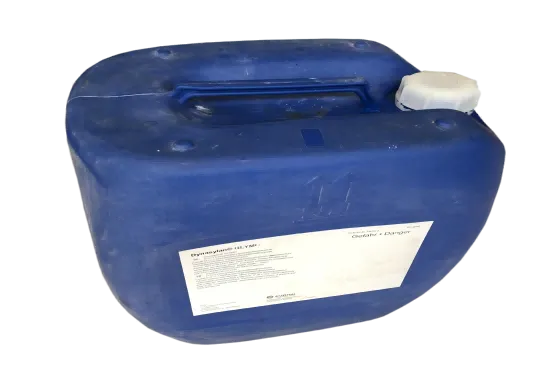
| Packaging | 25kg/200kg |
Evonik Dynasylan 1411 Diaminosilane Coupling Agent – Frequently Asked Questions (FAQ)
Q1: What is the primary function of Dynasylan 1411 in composite formulations?
A: Dynasylan 1411 acts as a bifunctional coupling agent that enhances interfacial adhesion between inorganic fillers (e.g., silica, glass fibers, or minerals) and organic polymer matrices—particularly epoxy, phenolic, polyurethane, and unsaturated polyester resins—by forming covalent bonds on both sides.
Q2: How should Dynasylan 1411 be handled and stored to maintain stability?
A: It should be stored in tightly sealed containers under inert atmosphere (e.g., nitrogen), protected from moisture and ambient air. Exposure to humidity accelerates self-condensation; therefore, it is recommended to use freshly opened or properly purged containers and avoid prolonged storage after opening.
Q3: Can Dynasylan 1411 be used in water-based systems?
A: While Dynasylan 1411 is hydrolytically sensitive and not directly dispersible in water, it can be pre-hydrolyzed under controlled acidic conditions and then carefully incorporated into aqueous dispersions—often with co-solvents or surfactants—to enable use in waterborne coatings or mineral binder systems.
Q4: What are typical dosage recommendations for Dynasylan 1411 in filled polymer systems?
A: Dosage depends on filler surface area and formulation requirements, but it is typically used at low concentrations—generally ranging from 0.1% to 2% by weight relative to the inorganic filler—and optimized via lab-scale trials to balance coupling efficiency and cost-effectiveness.
Q5: Does Dynasylan 1411 require a catalyst or heat activation for effective coupling?
A: No catalyst is strictly required, though elevated temperatures (e.g., during curing or drying steps) accelerate silanol condensation and covalent bond formation. In many thermoset systems, coupling proceeds efficiently during standard thermal processing without added catalysts.
 English
 Español
 tiếng việt
 русский