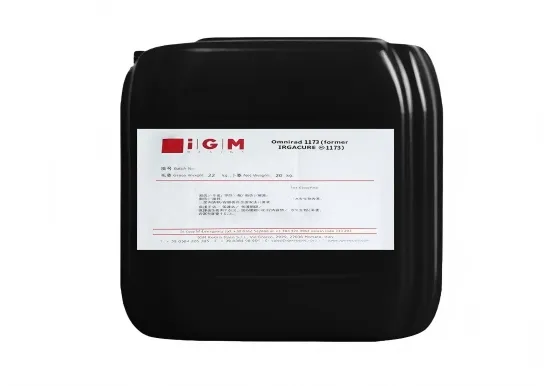
Features Of IGM Omnirad DETX UV Photoinitiator
Efficient free radical initiation - Hydrogen abstraction Type II initiation, rapidly generates free radicals, excellent curing efficiency
Significant synergistic effect - Used with tertiary amine synergists to greatly improve photoinitiating efficiency
Broad wavelength absorption - Adapts to specific UV wavelengths, suitable for various UV curing equipment
Solid easy processing - Powder form easy to meter and add, convenient storage and transportation, suitable for large-scale production
Broad system compatibility - Suitable for UV adhesives, coatings, inks and other systems, extremely strong versatility
Typical Applications Of IGM Omnirad DETX UV Photoinitiator
UV adhesives field - Various UV-curable adhesives, improving bond strength and curing speed
UV coatings field - Multi-substrate UV coatings, suitable for clear/colored systems, excellent curing effect
UV inks field - Printing inks, solder masks, ensuring printing precision and curing efficiency
Wood UV coatings - UV-curable coatings for wood surfaces, improving weatherability and surface performance
Electronic materials field - UV-curable coatings and photoresists for electronic components, ensuring product stability
Specifications Of IGM Omnirad DETX UV Photoinitiator
| Model | Omnirad DETX (DETX) |
| Brand | IGM (Omnirad® series, former BASF) |
| Chemical Type | Thioxanthone free-radical Type II UV photoinitiator |
| Chemical Name | 2,4-Diethyl-9H-thioxanthen-9-one |
| CAS No | 82799-44-8 |
| EINECS No | 280-041-0 |
| Molecular Formula | C17H16OS |
| Molecular Weight | 268.37 g/mol |
| Appearance (25℃) | Pale yellow powder |
IGM Omnirad DETX UV Photoinitiator – Frequently Asked Questions (FAQ)
Q1: What is the primary function of Omnirad DETX in UV-curable formulations?
A: Omnirad DETX is a highly efficient Type II photoinitiator that absorbs UV light and generates reactive species—primarily through hydrogen abstraction from co-initiators such as amines or ethers—to initiate polymerization of acrylate-based resins. It is especially valued for its strong absorption in the UVA region and excellent surface cure performance.
Q2: How does DETX compare to benzophenone in terms of yellowing and odor?
A: Compared to traditional benzophenone, DETX typically delivers significantly reduced post-cure yellowing and lower volatility, resulting in markedly less odor during processing and in final cured films—making it preferred for applications where appearance and workplace environment are critical.
Q3: What types of resins and monomers is DETX commonly used with?
A: DETX is widely compatible with multifunctional acrylates—including urethane acrylates, epoxy acrylates, and polyester acrylates—as well as reactive diluents like TPGDA and HDDA. It performs best when paired with amine co-initiators (e.g., EDB or MDEA) in free-radical UV systems.
Q4: Is DETX suitable for food-contact or medical-grade UV coatings?
A: While DETX itself is not inherently restricted for such uses, regulatory compliance depends on the full formulation, processing conditions, and end-use requirements. Customers targeting food-contact or medical applications must conduct full migration and biocompatibility testing per applicable regional regulations and consult IGM’s technical support for formulation guidance.
Q5: What is the typical dosage range for DETX in standard UV-curable inks and coatings?
A: DETX is typically used at low concentrations—generally ranging from 0.1% to 2% by weight relative to total formulation—depending on film thickness, substrate, lamp output, and desired cure speed. Optimal loading should be determined experimentally for each specific system.
 English
 Español
 tiếng việt
 русский