English
 Español
 tiếng việt
 русский
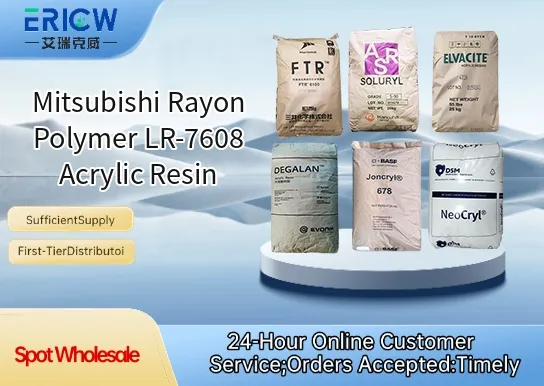
High-gloss, durable film formation with excellent clarity and UV resistance.
Outstanding weatherability and long-term color retention in outdoor exposure.
Good compatibility with common crosslinkers (e.g., melamine and isocyanate types) for enhanced chemical resistance.
Low VOC formulation suitable for environmentally compliant coating systems.
Excellent flow and leveling characteristics for smooth, defect-free finishes.
Automotive OEM and refinish topcoats.
Industrial maintenance coatings for architectural metal and machinery.
High-performance can and coil coatings.
Premium wood and plastic coatings requiring gloss and durability.
UV-curable hybrid coating systems (when formulated with photoinitiators).
| Chemical Type | Thermosetting acrylic copolymer |
| Product Form | Liquid resin solution (solvent-based) |
| Appearance | Clear, pale yellow to colorless liquid |
| Solids Content (wt%) | 50–55% (typical, as supplied) |
| Acid Value (mg KOH/g) | 15–25 |
| Weight Average Molecular Weight (Mw) | ~8,000–12,000 Da |
| Primary Applications | High-gloss industrial and automotive coatings |
| Key Features | UV stability, crosslinking versatility, low VOC potential |
Q1: What is the primary function of LR-7608 in coating formulations?
A: LR-7608 is a specialty acrylic polymer designed primarily as a rheology modifier and film-forming aid in water-based industrial and architectural coatings. It enhances viscosity stability, improves sag resistance, and contributes to uniform film formation without significantly compromising gloss or clarity.
Q2: Is LR-7608 compatible with common water-based resin systems?
A: Yes, LR-7608 demonstrates broad compatibility with acrylic emulsions, vinyl acetate copolymers, and styrene-acrylic dispersions. It is typically added during the let-down stage and remains stable across pH ranges of 7–9. Compatibility testing under specific formulation conditions is recommended prior to full-scale use.
Q3: How should LR-7608 be incorporated into a coating formulation?
A: LR-7608 is supplied as a ready-to-use aqueous dispersion and is generally added directly to the formulation at ambient temperature. It is recommended to introduce it after pigment grinding and before addition of other associative thickeners or surfactants to avoid interference with its performance.
Q4: Does LR-7608 affect drying time or block resistance in finished films?
A: LR-7608 supports rapid coalescence and contributes to improved early block resistance due to its optimized Tg profile. While it does not significantly extend drying time, final film hardness development may benefit from standard ambient curing conditions; forced drying is not required but can accelerate performance maturation.
Contact With Us:
E-mail: wangxingqiang@ericwchem.com
Have a Questions? Call Us:
Add:
Building A1, Jiete Industrial Park, Huangpu District, Guangzhou City, Guangdong Province, China