English
 Español
 tiếng việt
 русский
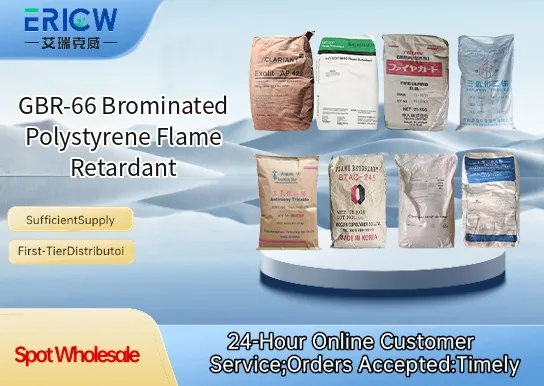
High bromine content (66–68 wt%) ensuring excellent flame retardancy in engineering thermoplastics.
Thermally stable up to 300 °C, compatible with high-processing-temperature polymers like PBT and PC/ABS blends.
Low volatility and minimal plate-out tendency during extrusion and injection molding.
Good compatibility with common polymer matrices without compromising mechanical properties.
Meets UL 94 V-0 rating at appropriate loading levels in standard test configurations.
Flame-retarded polybutylene terephthalate (PBT) for automotive connectors and under-hood components.
PC/ABS blends used in IT equipment housings and business machines.
Engineering plastics for electrical and electronic enclosures requiring stringent fire safety compliance.
Household appliance components where thermal stability and low smoke generation are critical.
Industrial control panels and power distribution units compliant with IEC 60695 standards.
| Chemical Type | Brominated polystyrene (BPS) |
| Product Form | Powder or free-flowing granules |
| Appearance | Off-white to light beige powder/granules |
| Bromine Content | 66–68 wt% (by XRF analysis) |
| Decomposition Onset Temperature | ≥290 °C (TGA, 5 °C/min, air) |
| Residue at 600 °C | ≤1.5 wt% |
| Moisture Content | ≤0.3 wt% |
| Key Regulatory Compliance | RoHS-compliant; REACH registered; no SCCPs or PBDEs |
Q1: What are the key advantages of GBR-66 compared to other brominated flame retardants?
A: GBR-66 offers excellent thermal stability and compatibility with engineering thermoplastics such as polyamide (PA), polybutylene terephthalate (PBT), and polycarbonate (PC) blends. Its polymeric structure minimizes volatility and migration, supporting long-term flame-retardant performance without significant impact on mechanical properties or processing behavior.
Q2: Is GBR-66 suitable for halogen-free compliance programs?
A: No — GBR-66 is a brominated flame retardant and therefore not compatible with halogen-free specifications. It is intended for applications where regulated bromine content is permitted and where high-performance flame retardancy in demanding polymer systems is required.
Q3: How is GBR-66 typically incorporated into polymer formulations?
A: GBR-66 is generally added during standard melt compounding processes — such as twin-screw extrusion — and disperses readily in molten thermoplastics. It is typically used at low concentrations, and dosage depends on formulation requirements, target flame class (e.g., UL 94 V-0), and polymer matrix.
Q4: Does GBR-66 require synergists like antimony trioxide to achieve optimal flame retardancy?
A: Yes — GBR-66 is commonly used in combination with antimony-based synergists to enhance flame-inhibiting efficiency, particularly in polyamide and polyester systems. The specific ratio and selection of synergist depend on end-use performance targets and regulatory considerations.
Contact With Us:
E-mail: wangxingqiang@ericwchem.com
Have a Questions? Call Us:
Add:
Building A1, Jiete Industrial Park, Huangpu District, Guangzhou City, Guangdong Province, China