English
 Español
 tiếng việt
 русский
Green & safe alternative:Free of phenoxyethanol, parabens, benzoic acid
Triple synergistic tech:Antimicrobial, booster & solubilizer for high efficacy
Wide pH tolerance:Stable at pH 4–8 for most personal care formulations
Excellent compatibility:Easy to formulate, stable in emulsion & surfactant systems
Eco-certified:High renewable carbon index, meets global eco-labels
Face & body care (toner, cleanser, lotion, cream)
Scalp & hair care products
Sun care & daily care formulas
Wet wipes & beauty cleaning products
Mild personal care for infants
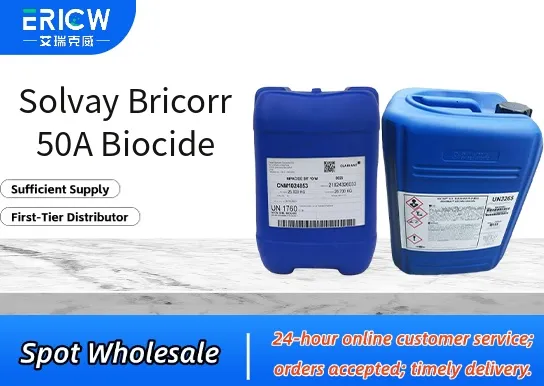
| Brand | Solvay |
| Division | Novecare |
| Product Series | BRICORR® A Series |
| Product Type | Multifunctional Water Treatment Biocide |
| Core Ingredient | Tetrakis(hydroxymethyl)phosphonium sulfate (THPS) |
| Core Functions | Biocidal, Corrosion Control, Acid Inhibition |
| Form | Liquid |
Q1: What is the primary mode of action of Nipaguard SCS?
A: Nipaguard SCS functions as a broad-spectrum fungistatic agent, primarily inhibiting the growth of mold, yeast, and certain bacteria by disrupting cellular membrane integrity and interfering with essential metabolic processes in susceptible microorganisms.
Q2: In which types of industrial formulations is Nipaguard SCS commonly used?
A: It is widely applied in water-based industrial coatings, adhesives, construction chemicals (e.g., tile grouts and sealants), metalworking fluids, and pigment dispersions—particularly where long-term storage stability and resistance to microbial spoilage are critical.
Q3: Is Nipaguard SCS compatible with common co-biocides or preservative systems?
A: Yes, Nipaguard SCS generally exhibits good compatibility with other widely used industrial biocides such as isothiazolinones and benzisothiazolinone derivatives, enabling synergistic combinations for enhanced spectrum and performance—but compatibility should always be verified experimentally within the final formulation matrix.
Q4: How does pH affect the performance of Nipaguard SCS?
A: Nipaguard SCS demonstrates stable antimicrobial activity across a broad pH range, typically from approximately pH 4 to pH 10, making it suitable for both mildly acidic and alkaline industrial systems without significant loss of efficacy.
Q5: What is the typical dosage range for effective preservation with Nipaguard SCS?
A: Effective dosage depends on formulation composition, challenge level, and regulatory context, but Nipaguard SCS is typically used at low concentrations—generally ranging from 0.1% to 2% by weight—based on extensive laboratory and field testing in relevant application matrices.
Contact With Us:
E-mail: wangxingqiang@ericwchem.com
Have a Questions? Call Us:
Add:
Building A1, Jiete Industrial Park, Huangpu District, Guangzhou City, Guangdong Province, China