English
 Español
 tiếng việt
 русский
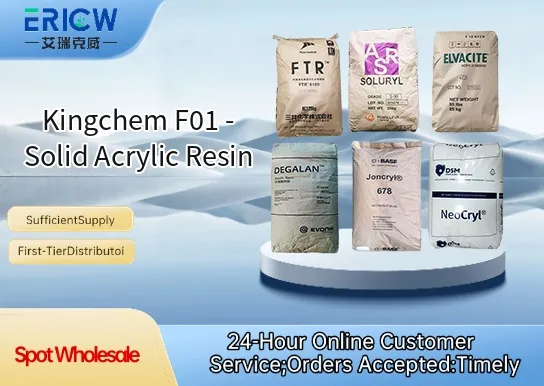
High molecular weight solid acrylic polymer offering excellent film-forming capability and mechanical strength.
Outstanding UV resistance and long-term color stability for outdoor durability.
Low volatile organic compound (VOC) content, supporting eco-friendly coating formulations.
Good compatibility with common solvents (e.g., xylene, butyl acetate) and crosslinkers such as melamine formaldehyde resins.
Thermoplastic behavior with high glass transition temperature (Tg ≈ 105–110°C), enabling heat-resistant finishes.
Automotive OEM and refinish topcoats requiring gloss retention and chip resistance.
Industrial maintenance coatings for metal substrates in architectural and infrastructure projects.
High-performance coil coatings for pre-painted steel and aluminum sheets.
Powder coating binders where thermal stability and flow control are critical.
UV-curable hybrid systems as a reactive diluent-compatible acrylic backbone.
| Chemical Type | Solid thermoplastic acrylic copolymer |
| Product Form | Free-flowing granular solid |
| Appearance | Off-white to pale yellow granules |
| Glass Transition Temperature (Tg) | 105–110°C (DSC, 10°C/min) |
| Acid Value | ≤ 5 mg KOH/g |
| Weight Average Molecular Weight (Mw) | 80,000–120,000 Da (GPC, PS standard) |
| Volatility (Loss on Heating at 150°C, 2 hrs) | ≤ 1.0 wt% |
| Storage Stability | Stable for 12 months at ≤ 30°C in sealed container |
Q1: What is the primary function of Kingchem F01 in coating and ink formulations?
A: Kingchem F01 serves as a high-performance film-forming binder and rheology modifier, enhancing gloss, hardness, and substrate adhesion while contributing to excellent clarity and UV stability in solvent-based and high-solids systems.
Q2: Is Kingchem F01 compatible with common industrial resins and crosslinkers?
A: Yes — it demonstrates broad compatibility with melamine formaldehyde resins, polyisocyanates, and other acrylic or polyester co-binders. Compatibility testing under actual formulation conditions is recommended due to system-specific variables such as solvent polarity and pH.
Q3: How should Kingchem F01 be incorporated into a formulation?
A: It is typically added during the let-down stage under moderate agitation. Pre-dilution in a compatible solvent (e.g., xylene, butyl acetate, or PGDA) is advised to ensure uniform dispersion and avoid agglomeration. Avoid high-shear mixing at elevated temperatures prior to full solvation.
Q4: Does Kingchem F01 require post-curing or thermal treatment to achieve optimal performance?
A: While it forms a coherent film at ambient temperature, full development of mechanical properties — including chemical resistance and hardness — generally benefits from forced-air drying or mild thermal curing (typically 80–120 °C), depending on film thickness and carrier system.
Q5: Can Kingchem F01 be used in low-VOC or high-solids applications?
A: Yes — its solid content and molecular design support formulating in high-solids coatings (≥65% NV) and low-VOC systems. Formulators often select it to reduce overall solvent demand without compromising flow, leveling, or film integrity.
Contact With Us:
E-mail: wangxingqiang@ericwchem.com
Have a Questions? Call Us:
Add:
Building A1, Jiete Industrial Park, Huangpu District, Guangzhou City, Guangdong Province, China