English
 Español
 tiếng việt
 русский
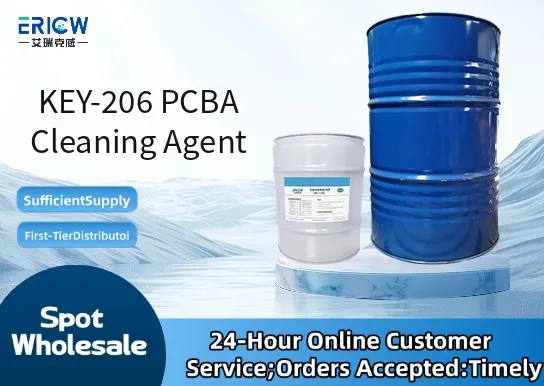
Non-halogenated, low-global-warming-potential (GWP) solvent formulation compliant with modern environmental regulations.
Fast-drying with zero residue—leaves no ionic or non-volatile contaminants on sensitive PCBAs.
Material-safe for common electronics substrates including FR-4, solder mask, conformal coatings, and most plastics (e.g., ABS, polycarbonate).
Low surface tension and high solvency power for effective removal of rosin, no-clean flux residues, light oils, and particulate soils.
Stable under ambient storage conditions; non-corrosive to metals including copper, tin-lead, and ENIG finishes.
Post-reflow cleaning of high-density SMT assemblies in aerospace and defense electronics.
Final cleaning of medical device PCBAs prior to sterilization and packaging.
In-line or batch cleaning of automotive control units (ECUs, ADAS modules) requiring ultra-low chloride/ionic residue limits.
Manual wipe-down or aerosol cleaning of prototype and rework boards in R&D labs.
Cleaning prior to conformal coating application to ensure optimal adhesion and dielectric integrity.
| Chemical Type | Hydrofluoroether (HFE)-based blended solvent system |
| Product Form | Liquid (ready-to-use) |
| Appearance | Clear, colorless liquid |
| Odor | Very mild, non-irritating ether-like odor |
| Primary Applications | PCBA flux and process residue removal; precision electronics cleaning |
| Key Features | Non-flammable (flash point > 60 °C), non-ozone-depleting, RoHS-compliant |
| Benefits | No rinsing required; compatible with vapor degreasing, spray-in-air, and ultrasonic systems |
| Regulatory Compliance | REACH SVHC-free, Prop 65 compliant, TSCA-listed |
| Common Compatible Systems | Suitability |
| Vapor Degreasing (e.g., AqueousTech, Techspray systems) | Highly Recommended – Optimized boiling point and condensation profile for closed-loop recovery |
| Batch Spray-in-Air Cabinets (e.g., Lytron, Zestron) | Highly Recommended – Excellent atomization and soil lift without overspray or pooling |
| Ultrasonic Cleaning Tanks (25–45 kHz) | Recommended – Effective at moderate frequencies; avoid prolonged exposure above 50 °C |
| Manual Wipe & Aerosol Application | Suitable – Low evaporation rate enables controlled dwell time; non-staining on optics-grade surfaces |
Q1: What is the CAS Registry Number for KEY-206?
A: The primary active component has CAS No. 406-58-6 (trans-1-Chloro-3,3,3-trifluoropropene, though formulated as a proprietary HFE blend; full composition available under NDA upon request).
Q2: What is the recommended usage concentration and temperature range?
A: KEY-206 is supplied ready-to-use. For vapor degreasing: boil sump temperature 49–52 °C; for spray systems: ambient to 40 °C; no dilution required.
Q3: How does KEY-206 compare to traditional nPB or TCE-based cleaners?
A: Unlike nPB (a suspected carcinogen) or TCE (a known human carcinogen), KEY-206 contains no OSHA-regulated hazardous air pollutants (HAPs) and carries no workplace exposure limits (WELs) per current ECHA guidance.
Q4: Is KEY-206 suitable for cleaning components prior to ion chromatography testing?
A: Yes—validated to yield <0.2 µg/cm² NaCl-equivalent ionic residue per IPC-J-STD-001 and IPC-TM-650 2.3.25.1 protocols when used per recommended process parameters.
Q5: Does KEY-206 extract plasticizers or cause swelling in polymeric connectors?
A: No—extensive compatibility testing shows no measurable extraction of DINP, DEHP, or DOTP from PVC, nylon, or LCP housings after 10-minute immersion at 25 °C.
Contact With Us:
E-mail: wangxingqiang@ericwchem.com
Have a Questions? Call Us:
Add:
Building A1, Jiete Industrial Park, Huangpu District, Guangzhou City, Guangdong Province, China