English
 Español
 tiếng việt
 русский
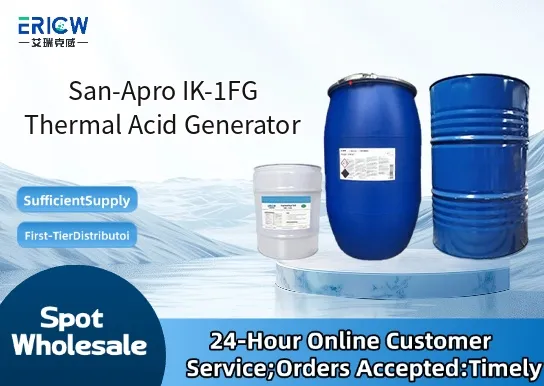
Thermally activated — releases strong Brønsted acid upon heating (onset ~130 °C), enabling precise spatial and temporal control of acid-catalyzed reactions.
Low volatility and excellent thermal stability below activation temperature — minimizes premature decomposition during formulation and storage.
High acid strength (H₀ ≈ –2.5) post-decomposition — effective for demanding catalytic applications including crosslinking and deprotection.
Halogen-free molecular structure — supports environmentally responsible formulation design and regulatory compliance.
Excellent compatibility with common photoresists, epoxy resins, and polyimide precursors — ensures homogeneous dispersion and minimal phase separation.
Chemical amplification in advanced 193-nm and EUV photoresists for semiconductor lithography.
Catalyst for thermosetting epoxy–phenolic resin systems used in printed circuit board (PCB) laminates.
Acid-triggered imidization accelerator in polyimide precursor coatings for flexible electronics.
Latent catalyst in high-performance powder coatings requiring low-cure-temperature performance.
Controlled-release acid source in microelectronic encapsulants and underfill materials.
| Chemical Type | Sulfonium salt derivative (triphenylsulfonium-based, non-iodide) |
| Product Form | White to off-white crystalline powder |
| Appearance | Free-flowing fine crystalline solid |
| Melting Point | 148–152 °C (DSC onset) |
| Onset Decomposition Temperature | 132–136 °C (TGA, 10 °C/min, N₂) |
| Primary Applications | Latent acid catalyst for photoresists, epoxy resins, polyimides |
| Key Features | Halogen-free, low volatility, high thermal latency, clean acid generation |
| Regulatory Compliance | REACH registered; RoHS 2011/65/EU compliant; no SVHCs above threshold |
| Common Compatible Systems | Suitability |
| Standard novolac–DNQ photoresists | Recommended – Effective as secondary acid amplifier in hybrid resist platforms |
| Epoxy–dicyandiamide (DICY) curing systems | Highly Recommended – Enhances mid-temperature cure kinetics without compromising pot life |
| Polyamic acid solutions (e.g., PMDA–ODA) | Highly Recommended – Accelerates thermal imidization at 180–220 °C with improved film uniformity |
| Acrylic–melamine thermoset coatings | Suitable – Requires optimization of bake profile to align acid release with crosslinking window |
Q1: What is the CAS Registry Number for San-Apro IK-1FG?
A: The CAS Registry Number for San-Apro IK-1FG is 2279475-82-1.
Q2: What is the typical recommended loading level in epoxy formulations?
A: Standard loading ranges from 0.5 to 2.0 wt% relative to total resin solids, depending on desired cure speed and final Tg; optimization via DSC is recommended.
Q3: How does IK-1FG differ from conventional iodonium-based thermal acid generators?
A: IK-1FG is iodide-free and sulfonium-based with superior thermal latency and reduced risk of halogen-induced corrosion or metal migration in microelectronics packaging.
Q4: Is San-Apro IK-1FG compliant with food-contact or medical device regulations?
A: It is not intended for direct food contact or implantable medical devices; however, it meets ISO 10993-5 (cytotoxicity) when fully cured in epoxy matrices per qualified process.
Q5: Has migration or extraction testing been performed in polymer matrices?
A: Yes — validated per IEC 62321-7-2 for low extractables in cured epoxy films (<0.05 ppm in 10% ethanol at 60 °C, 24 h) under standard processing conditions.
Contact With Us:
E-mail: wangxingqiang@ericwchem.com
Have a Questions? Call Us:
Add:
Building A1, Jiete Industrial Park, Huangpu District, Guangzhou City, Guangdong Province, China