English
 Español
 tiếng việt
 русский
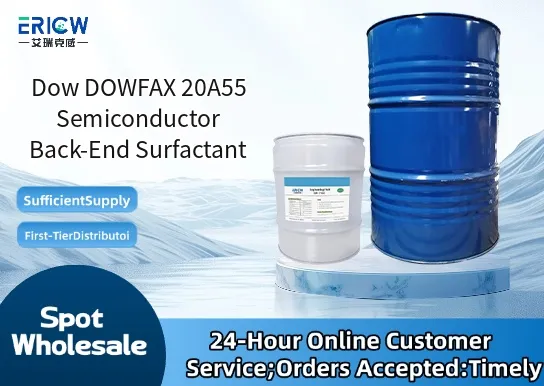
Ultra-low residue formulation engineered specifically for semiconductor back-end cleaning and rinse processes.
Exceptional wetting and surface tension reduction in deionized water at low concentrations (0.01–0.1 wt%).
Nonionic, alcohol ethoxylate-based chemistry with minimal ionic impurities (<1 ppm Na⁺, K⁺, Cl⁻).
Thermally stable up to 80 °C and compatible with standard wafer track and spin-rinse-dry (SRD) equipment.
Designed for rapid, complete removal during post-CMP and post-etch rinse steps—no measurable carbon or metal contamination per SEMI F57 testing.
Post-chemical mechanical polishing (post-CMP) rinse for copper/low-k interconnect structures.
Residue removal after plasma etch and ash processes in advanced packaging (e.g., fan-out wafer-level packaging).
Surface conditioning prior to die attach, underfill dispensing, or molding compound application.
Rinse aid in high-throughput wafer-level cleaning systems operating with DI water at 20–60 °C.
Compatibility enhancer in formulated semiconductor back-end process chemicals (e.g., dilute SC-1 variants).
| Chemical Type | Nonionic surfactant – branched alcohol ethoxylate (C12–C15, avg. EO = 5.5) |
| Product Form | Clear, colorless to pale yellow liquid |
| Appearance | Homogeneous liquid, free of particulates and phase separation |
| Active Content (wt%) | 99.0–100.0% (by HPLC) |
| Primary Applications | Semiconductor back-end rinse, post-CMP cleaning, post-etch residue management |
| Key Features | Low foaming, ultra-low ionic/organic residue, high DI-water solubility |
| Benefits | Reduces pattern collapse, improves yield in sub-10 nm nodes, enables single-rinse efficiency |
| Regulatory Compliance | REACH registered; RoHS 2 compliant; no SVHCs above 0.1% threshold |
| Common Compatible Systems | Suitability |
| Spin-Rinse-Dry (SRD) tools (e.g., Tokyo Electron, SCREEN) | Highly Recommended – Validated for full-process integration with <0.5 ppm residual carbon |
| Dilute SC-1 (NH₄OH:H₂O₂:H₂O) formulations | Recommended – Enhances particle removal without increasing metal leaching |
| Deionized water rinse modules (20–60 °C) | Highly Recommended – Optimal performance at 0.025–0.075 wt% concentration |
| Wafer track dispense systems (e.g., DNS, Kokusai) | Suitable – Compatible with stainless steel and PFA fluid paths; no gasket swelling observed |
Q1: What is the CAS Registry Number for DOWFAX 20A55?
A: The CAS Registry Number is 68439-49-6 (representative for the C12–C15 alcohol ethoxylate mixture with average EO=5.5).
Q2: What is the recommended use concentration in DI water rinse applications?
A: Typical dosage is 0.025–0.075 wt% (250–750 ppm) in ultrapure DI water; optimization via QCM or surface potential measurement is advised for specific tool configurations.
Q3: How does DOWFAX 20A55 compare to DOWFAX C10 or DOWFAX 8390 in back-end applications?
A: Unlike DOWFAX C10 (higher foaming, higher EO) or DOWFAX 8390 (anionic, unsuitable for metal-sensitive processes), 20A55 offers nonionic stability, lower foam, and validated compatibility with Cu/low-k stacks and BEOL metrology.
Q4: Is DOWFAX 20A55 subject to extractables or leachables concerns in high-purity rinse systems?
A: No significant extractables observed per SEMI F57 and USP <661.3> testing; validated for ≤0.1 ng/cm² organic extractables after 72-hr contact with PFA and quartz at 60 °C.
Contact With Us:
E-mail: wangxingqiang@ericwchem.com
Have a Questions? Call Us:
Add:
Building A1, Jiete Industrial Park, Huangpu District, Guangzhou City, Guangdong Province, China