English
 Español
 tiếng việt
 русский
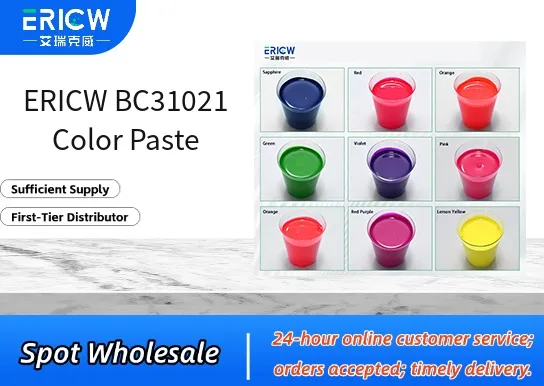
High chroma and excellent color consistency across batches.
Optimized dispersion stability in water-based and solvent-based systems.
Low VOC content, compliant with major global environmental regulations.
Excellent heat resistance up to 180°C for demanding processing conditions.
Good compatibility with acrylic, polyester, and polyurethane resin systems.
Architectural and industrial waterborne coatings.
Automotive refinish and OEM basecoat systems.
Plastic coloration for ABS, PS, and PVC compounds.
Wood finishes and furniture lacquers.
Ink formulations for packaging gravure and flexographic printing.
| Chemical Type | Organic pigment dispersion |
| Product Form | Viscous liquid paste |
| Appearance | Homogeneous, non-settling paste with uniform color tone |
| Primary Applications | Coatings, inks, and plastic coloration |
| Key Features | High tinctorial strength, low dusting, easy incorporation |
| Benefits | Reduced formulation time, improved batch-to-batch reproducibility |
| pH (10% aqueous dilution) | 7.0–8.5 |
| Storage Stability | 12 months at 5–30°C in sealed container |
Q1: What types of polymer systems is ERICW BC31021 Color Paste compatible with?
A: ERICW BC31021 is formulated for compatibility with common thermoplastics including polyethylene (PE), polypropylene (PP), and polystyrene (PS), as well as certain engineering resins. Compatibility should be verified under actual processing conditions due to variations in resin grade, additives, and thermal history.
Q2: How should ERICW BC31021 be incorporated into a polymer melt?
A: It is typically introduced via gravimetric or volumetric dosing directly into the extruder feed throat or side feeder. Pre-blending with carrier resin or masterbatch dilution may be used to ensure uniform dispersion, especially at lower dosage levels.
Q3: Is ERICW BC31021 suitable for food-contact applications?
A: ERICW BC31021 is designed for general industrial use. For food-contact applications, end-use compliance must be confirmed by the compounder or converter through full regulatory assessment—including migration testing and verification against applicable regional requirements—based on the final formulation and processing conditions.
Q4: What storage conditions are recommended to maintain stability?
A: Store in original sealed containers at temperatures between 5°C and 30°C, away from direct sunlight and sources of heat or moisture. Avoid freezing, and ensure containers remain tightly closed when not in use to prevent skinning or viscosity changes.
Contact With Us:
E-mail: wangxingqiang@ericwchem.com
Have a Questions? Call Us:
Add:
Building A1, Jiete Industrial Park, Huangpu District, Guangzhou City, Guangdong Province, China