English
 Español
 tiếng việt
 русский
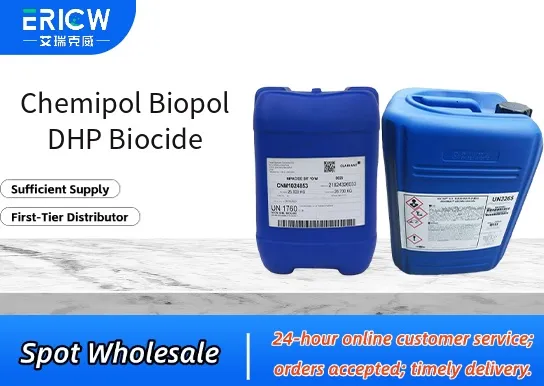
Effective broad-spectrum biocidal activity against bacteria, fungi, and algae.
Stable under a wide pH range (pH 4–10) and compatible with common water treatment additives.
Low toxicity profile with favorable environmental and handling safety characteristics.
Non-oxidizing chemistry that minimizes corrosion risk in industrial cooling and process water systems.
Ready-to-use liquid formulation requiring no activation or dilution for standard dosing protocols.
Industrial cooling water systems (open recirculating and closed-loop).
Process water circuits in paper mills and pulp manufacturing facilities.
Oilfield produced water and injection water treatment programs.
Membrane filtration feedwater protection in desalination and wastewater reuse plants.
Preservation of water-based metalworking fluids and emulsions.
| Chemical Type | Heterocyclic Dihydroxy Pyrimidine derivative |
| Product Form | Aqueous liquid solution |
| Appearance | Clear, pale yellow to amber liquid |
| pH (as supplied) | 6.5–7.5 |
| Active Ingredient Content | ≥10.0% w/w |
| Density (20°C) | 1.08–1.12 g/cm³ |
| Solubility in Water | Completely miscible |
| Storage Stability | ≥24 months in original sealed container at 5–30°C |
Q1: What types of microorganisms does Chemipol Biopol DHP Biocide effectively control?
A: Chemipol Biopol DHP Biocide is formulated to provide broad-spectrum activity against bacteria, yeasts, and molds commonly encountered in water-based polymer dispersions, coatings, adhesives, and other industrial formulations.
Q2: Is Chemipol Biopol DHP Biocide compatible with anionic, cationic, and nonionic systems?
A: Yes — Chemipol Biopol DHP Biocide demonstrates good compatibility across a wide range of surfactant types and emulsion polymer chemistries, including anionic, nonionic, and many cationic systems, though compatibility testing under actual formulation conditions is recommended.
Q3: How should Chemipol Biopol DHP Biocide be added to a formulation?
A: It is typically added during the final stage of manufacturing, after cooling and pH adjustment, to minimize thermal degradation and ensure optimal stability and performance. Pre-dilution with water or a compatible solvent may facilitate uniform dispersion.
Q4: What is the typical dosage range for Chemipol Biopol DHP Biocide in industrial applications?
A: Dosage depends on formulation composition, process conditions, and microbial challenge level, but it is generally used at low concentrations — typically ranging from 0.1% to 2.0% by weight of the total formulation — with optimization recommended through preservative efficacy testing.
Q5: Does Chemipol Biopol DHP Biocide require pH adjustment for optimal performance?
A: Its antimicrobial activity is most effective within a mildly acidic to neutral pH range (approximately pH 4–8); significant deviations outside this range may reduce stability or efficacy, so monitoring and maintaining appropriate pH during storage and use is advised.
Contact With Us:
E-mail: wangxingqiang@ericwchem.com
Have a Questions? Call Us:
Add:
Building A1, Jiete Industrial Park, Huangpu District, Guangzhou City, Guangdong Province, China