English
 Español
 tiếng việt
 русский
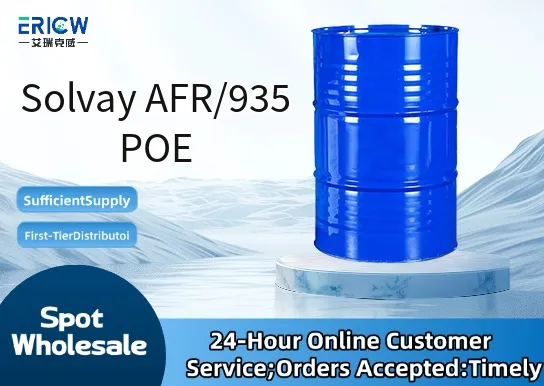
Highly stable polyolester (POE) base fluid engineered for compatibility with next-generation low-GWP refrigerants including HFC-32, HFO-1234yf, and R-744 (CO₂).
Excellent thermal and oxidative stability under demanding compressor operating conditions, minimizing sludge and acid formation.
Superior miscibility and solubility with polar refrigerants, ensuring consistent oil return and system reliability.
Low pour point (≤ −45 °C) and favorable viscosity-temperature behavior for reliable low-temperature performance.
Non-corrosive to common HVAC&R system metals (copper, steel, aluminum) and compatible with standard elastomers and seals.
Rotary and scroll compressors in residential and commercial air conditioning systems using R-32 or R-454B.
Mobile air conditioning units in electric and hybrid vehicles operating with R-1234yf.
CO₂ transcritical refrigeration systems for supermarket cold rooms and heat pump water heaters.
Low-charge VRF (Variable Refrigerant Flow) systems requiring high oil-refrigerant miscibility and long-term stability.
Hermetic and semi-hermetic compressors in heat pumps designed for ultra-low ambient operation.
| Chemical Type | Polyolester (POE) synthetic lubricant |
| Product Form | Clear, amber liquid |
| Appearance | Transparent, homogeneous liquid |
| Primary Applications | Lubricant for HFC, HFO, and CO₂-based refrigeration and air conditioning compressors |
| Key Features | Refrigerant miscibility, thermal stability, low pour point, non-corrosive |
| Viscosity Grade (ISO) | ISO VG 32 (at 40 °C) |
| Acid Number (mg KOH/g) | < 0.1 |
| Water Content (ppm) | < 50 |
Q1: What is Solvay AFR/935 POE and how does it differ from conventional plasticizers?
A: Solvay AFR/935 POE is a polyolester-based processing aid and lubricant specifically developed for high-performance thermoplastic elastomers and engineering polymers. Unlike traditional phthalate or adipate plasticizers, it offers enhanced thermal stability, low volatility, and improved compatibility with polar polymer matrices—making it suitable for demanding processing conditions and long-term service applications.
Q2: Which polymer systems is AFR/935 POE most commonly used with?
A: It is widely selected for use in thermoplastic polyurethane (TPU), thermoplastic vulcanizates (TPV), and certain polyamide (PA) and polyester (PBT/PET) compounds where reduced melt viscosity, improved flow, and enhanced surface finish are required—particularly in extrusion and injection molding of thin-walled or complex geometries.
Q3: Is AFR/935 POE compatible with common stabilizer packages and other additives?
A: Yes—AFR/935 POE demonstrates good compatibility with typical phenolic antioxidants, phosphites, and hindered amine light stabilizers (HALS). However, as with any additive, compatibility should be verified under actual processing and end-use conditions due to potential interactions with acid scavengers or reactive co-additives.
Q4: How is AFR/935 POE typically incorporated into polymer formulations?
A: It is generally introduced during compounding—either pre-blended with the base resin or metered directly into the extruder feed throat or side-stuffer. Due to its liquid form and low volatility, it integrates efficiently at typical melt temperatures and generally ranges from 0.1% to 2% by weight depending on the target rheology and final part requirements.
Contact With Us:
E-mail: wangxingqiang@ericwchem.com
Have a Questions? Call Us:
Add:
Building A1, Jiete Industrial Park, Huangpu District, Guangzhou City, Guangdong Province, China