English
 Español
 tiếng việt
 русский

Highly selective for diene hydrogenation, minimizing over-hydrogenation to saturated alkanes.
Thermally stable under industrial fixed-bed and slurry-phase reactor conditions.
Low palladium loading enables cost-efficient operation without compromising activity.
Engineered for excellent resistance to sulfur and nitrogen-containing impurities in feedstocks.
Consistent batch-to-batch performance validated through Clariant’s ISO 9001-certified manufacturing.
Selective hydrogenation of C4–C8 diolefins in petrochemical naphtha and cracked gasoline streams.
Purification of butadiene feedstock for synthetic rubber production (e.g., SBR, BR).
Removal of residual dienes from polymer-grade isoprene and piperylene.
Upgrading of bio-derived hydrocarbon intermediates containing conjugated diene impurities.
Refining of specialty solvents requiring ultra-low diene content (<1 ppm).
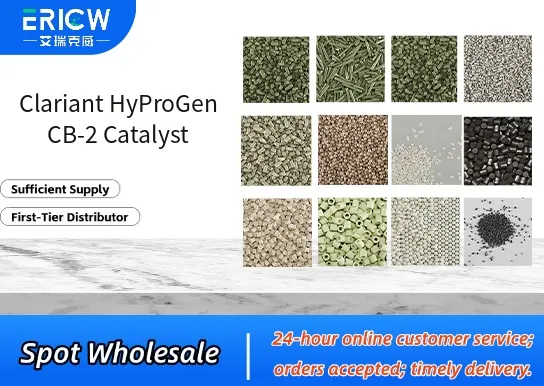
| Chemical Type | Palladium-based heterogeneous catalyst on high-surface-area alumina support |
| Product Form | Extruded cylindrical pellets (3 mm diameter × 3–5 mm length) |
| Appearance | Gray-black free-flowing granular solid |
| Primary Applications | Selective hydrogenation of conjugated and isolated dienes in liquid-phase and low-pressure gas-phase processes |
| Key Features | High diene selectivity, poison tolerance, thermal stability, reproducible activity |
| Benefits | Extended catalyst life, reduced shutdown frequency, improved product purity, lower Pd consumption |
| Storage Conditions | Store in sealed containers under inert atmosphere at ambient temperature |
| Handling Precautions | Avoid exposure to air when hot; use appropriate PPE during loading/unloading |
Q1: What is the primary function of the CATADIENE Catalyst in polymer synthesis?
A: The CATADIENE Catalyst is a specialized transition metal-based system designed to enable highly selective diene polymerization and copolymerization—particularly for butadiene and isoprene—supporting controlled microstructure development (e.g., high cis-1,4 content) and improved molecular weight distribution in synthetic elastomers.
Q2: Is CATADIENE compatible with common polar monomers or functionalized dienes?
A: Yes—CATADIENE exhibits robust performance in the presence of moderately polar monomers and functionalized dienes, though optimal activity and selectivity are typically achieved under anhydrous, oxygen-free conditions. Compatibility should be verified experimentally for specific monomer combinations and process environments.
Q3: How is CATADIENE typically dosed in industrial polymerization processes?
A: It is generally used at low concentrations, with dosage depending on formulation requirements, desired reaction kinetics, and target polymer properties. Typical loading ranges from 0.1% to 2% by weight relative to monomer charge, often introduced as a preformed complex or via sequential addition of co-catalyst components.
Q4: What storage and handling precautions are recommended for CATADIENE?
A: CATADIENE is moisture- and air-sensitive. It must be stored under inert atmosphere (e.g., nitrogen or argon), protected from light and humidity, and handled using standard Schlenk-line or glovebox techniques. Solutions should be prepared fresh or stabilized with appropriate solvents and stabilizers per Clariant’s technical guidance.
Contact With Us:
E-mail: wangxingqiang@ericwchem.com
Have a Questions? Call Us:
Add:
Building A1, Jiete Industrial Park, Huangpu District, Guangzhou City, Guangdong Province, China