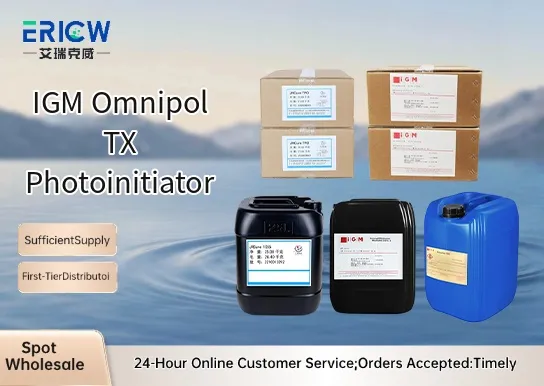
Features Of IGM Esacure ES 198 Photoinitiator
Significant synergistic effect - Compounded with Type II photoinitiators, greatly improving curing speed and enhancing deep curing effect
Dual-system adaptability - Suitable for both transparent and pigmented UV systems, wide application range, no impact on system color
Low odor and low yellowing - Extremely low odor during curing, no obvious yellowing after curing, maintaining product appearance texture
Low migration and low extraction - Special molecular structure, meeting low migration and low extraction value requirements, suitable for strict scenarios
Easy compounding and processing - Good compatibility with various UV formulations, easy to disperse and weigh, convenient operation, improving production efficiency
Typical Applications Of IGM Esacure ES 198 Photoinitiator
Transparent UV varnishes - Transparent varnishes for wood, glass and plastic, low yellowing, maintaining high light transmittance and gloss
Pigmented UV coatings - Wood and plastic pigmented UV coatings, fast curing, full color and good wear resistance
UV ink field - Screen and offset UV inks, suitable for paper and plastic substrates, clear printing and low odor
Food packaging UV systems - Low migration and low extraction, suitable for food packaging-related UV curing products, safe and compliant
High-end UV adhesives - Transparent and pigmented UV adhesives, high bonding strength, no yellowing, suitable for precision bonding scenarios
Specifications Of IGM Esacure ES 198 Photoinitiator
| Brand & Series | IGM (Esacure series) |
| Chemical Type | Amine synergist (UV curing synergistic additive) |
| Chemical Composition | Polyfunctional high-molecular-weight amine compound |
| Alias | ES 198 Amine Synergist, UV Synergistic Curing Additive, Esacure 198 |
| CAS No | 104102-82-5 |
| Molecular Formula | C22H30N2O2 |
| Appearance (25°C) | Pale yellow to yellow transparent liquid |
| Purity | ≥98.0% |
| Molecular Weight | 354.49 g/mol |
IGM Esacure ES 198 Photoinitiator – Frequently Asked Questions (FAQ)
Q1: What is the primary photoreactivity profile of Esacure ES 198?
A: Esacure ES 198 is a Type II photoinitiator based on benzophenone chemistry, requiring a co-initiator (e.g., tertiary amine) to generate reactive species under UV-A and visible light exposure. It exhibits strong absorption in the 320–390 nm range and is especially effective in low-intensity or LED-UV curing systems.
Q2: Is Esacure ES 198 suitable for food-contact or medical-grade formulations?
A: Esacure ES 198 is not pre-approved for direct food-contact applications under major global regulatory frameworks. Its suitability for sensitive end-uses depends on full formulation assessment, migration testing, and compliance verification by the formulator — IGM does not provide regulatory clearance for final applications.
Q3: How does ES 198 compare to traditional benzophenone in terms of odor and yellowing?
A: Compared to standard benzophenone, ES 198 offers significantly reduced volatility and lower residual odor post-cure. It also demonstrates improved resistance to yellowing in clear coatings and inks, particularly when stabilized appropriately and cured under controlled UV conditions.
Q4: What types of resin systems show optimal compatibility with ES 198?
A: ES 198 performs well in acrylate-based systems including multifunctional acrylates, urethane acrylates, and epoxy acrylates. It is also compatible with many vinyl ether and hybrid formulations, though performance should be verified experimentally due to sensitivity to oxygen inhibition and co-initiator selection.
Q5: What is the typical dosage range for Esacure ES 198 in industrial formulations?
A: Dosage depends on substrate, film thickness, light source intensity, and desired cure speed, but it is typically used at low concentrations — generally ranging from 0.1% to 2% by weight relative to total formulation solids. Optimization requires empirical testing under actual production conditions.
 English
 Español
 tiếng việt
 русский