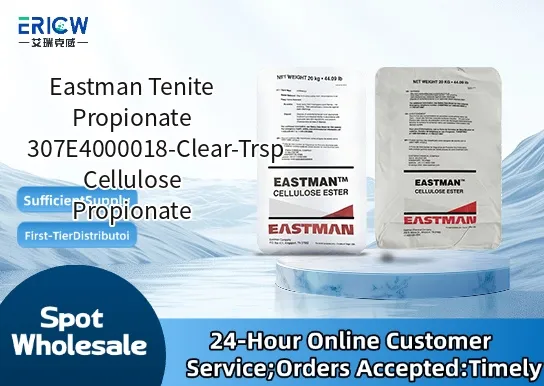
Features Of Eastman Tenite Propionate 307E4000018-Clear-Trsp Cellulose Propionate
High optical clarity with excellent transparency and low haze for premium visual applications.
Good dimensional stability and low moisture absorption compared to other cellulose esters.
Excellent thermoformability and ease of processing via injection molding, extrusion, and vacuum forming.
UV-stable formulation with inherent resistance to yellowing under prolonged light exposure.
Non-toxic, FDA-compliant for indirect food contact applications when processed per regulatory guidelines.
Typical Applications Of Eastman Tenite Propionate 307E4000018-Clear-Trsp Cellulose Propionate
Transparent lenses and optical components for consumer electronics and lighting fixtures.
Decorative trim and interior automotive parts requiring clarity and surface hardness.
Medical device housings and diagnostic components where biocompatibility and sterilizability are critical.
Consumer product casings for eyewear frames, cosmetic packaging, and premium accessories.
Architectural glazing elements and signage requiring weather-resistant transparency.
Specifications Of Eastman Tenite Propionate 307E4000018-Clear-Trsp Cellulose Propionate
| Chemical Type | Cellulose propionate |
| Product Form | Pellets |
| Appearance | Clear, transparent, colorless pellets |
| Primary Applications | Optical components, medical devices, consumer goods, automotive interiors |
| Key Features | Clarity, thermoformability, UV stability, low moisture uptake |
| Benefits | Replacement for acrylic and polycarbonate in select applications requiring lower stress cracking and improved processability |
| Regulatory Status | FDA compliant for indirect food contact (21 CFR §177.1010); RoHS and REACH compliant |
| Processing Method | Injection molding, extrusion, thermoforming |
Eastman Tenite Propionate 307E4000018-Clear-Trsp Cellulose Propionate – Frequently Asked Questions (FAQ)
Q1: What are the key processing advantages of Eastman Tenite Propionate 307E4000018 compared to other cellulose esters?
A: This grade offers improved melt stability and reduced thermal sensitivity during extrusion and injection molding, enabling smoother processing at moderate temperatures. Its low moisture sensitivity also simplifies drying requirements relative to many acetate-based cellulose esters.
Q2: Is this material suitable for applications requiring optical clarity and dimensional stability?
A: Yes — Eastman Tenite Propionate 307E4000018 is specifically formulated as a clear, transparent grade with excellent inherent clarity and low birefringence. It maintains good dimensional stability under ambient conditions and exhibits minimal warpage in thin-walled molded parts.
Q3: How does this propionate grade perform in terms of chemical resistance and surface hardness?
A: It demonstrates good resistance to aliphatic hydrocarbons, vegetable oils, and weak acids, though it is less resistant to strong solvents like ketones or chlorinated hydrocarbons. Surface hardness is higher than standard cellulose acetate, contributing to improved scratch resistance in finished articles.
Q4: Can this material be used in applications requiring regulatory compliance for indirect food contact?
A: Eastman Tenite Propionate resins are designed to meet general requirements for indirect food contact under widely recognized global frameworks; however, final compliance depends on the complete formulation, processing conditions, and applicable regional regulations — users must conduct their own evaluation and verification.
 English
 Español
 tiếng việt
 русский