English
 Español
 tiếng việt
 русский
Excellent thermal stability up to 800°C, maintaining color integrity under high-temperature processing.
High opacity and strong tinting strength, enabling efficient coverage with low dosage.
Outstanding chemical resistance to acids, alkalis, and solvents, ensuring long-term performance in aggressive environments.
Non-toxic and heavy-metal-free formulation, compliant with RoHS and REACH regulations.
Consistent particle size distribution for uniform dispersion and minimal sedimentation in liquid systems.
Ceramic glazes and underglaze decorations for tableware and architectural tiles.
High-performance coatings for industrial equipment and automotive heat-resistant components.
Plastic coloration for engineering thermoplastics requiring thermal and UV stability.
Specialty inks for glass and metal decoration requiring firing or baking steps.
Refactory materials and heat-resistant concrete pigments.
| Chemical Type | Mixed Metal Oxide (Spinel-based) |
| Product Form | Free-flowing fine powder |
| Appearance | Uniform reddish-brown granular powder |
| Primary Applications | Ceramics, high-temp coatings, engineering plastics, refractories |
| Key Features | Thermal stability, chemical inertness, lightfastness, non-volatility |
| Benefits | Reduced dosage requirement, consistent batch-to-batch color, low abrasivity |
| Density | ~4.2 g/cm³ |
| Particle Size (D50) | 1.8–2.2 μm |
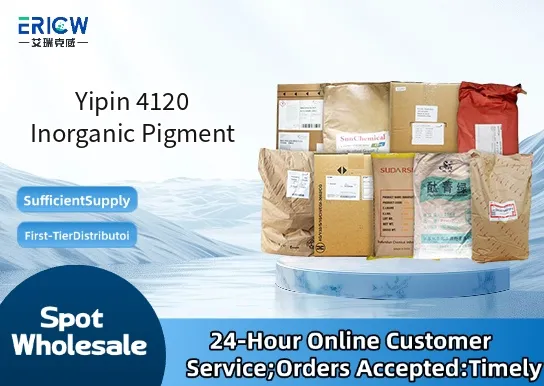
Q1: What is the primary chemical composition of Yipin 4120?
A: Yipin 4120 is a mixed-metal oxide pigment based on iron and chromium, engineered to deliver stable brown-to-black hues with excellent thermal and chemical resistance.
Q2: Is Yipin 4120 suitable for high-temperature processing applications?
A: Yes — it exhibits outstanding thermal stability and is commonly used in applications involving extrusion, calendering, and sintering processes where temperatures exceed 800 °C.
Q3: How does Yipin 4120 perform in UV-exposed outdoor applications?
A: It offers excellent UV stability and weather resistance due to its fully inorganic, crystalline structure, making it well-suited for long-term outdoor use in coatings, construction materials, and polymer composites.
Q4: What is the typical dosage range when incorporating Yipin 4120 into polymer systems?
A: Dosage depends on the desired shade intensity and substrate opacity, but it is generally used at low concentrations — typically ranging from 0.1% to 2% by weight in most thermoplastic and thermoset formulations.
Q5: Can Yipin 4120 be dispersed using standard industrial equipment?
A: Yes — it is readily dispersible using conventional high-shear mixers, bead mills, or two-roll mills. Optimal dispersion is achieved with appropriate wetting agents and process time, especially in non-aqueous systems.
Contact With Us:
E-mail: wangxingqiang@ericwchem.com
Have a Questions? Call Us:
Add:
Building A1, Jiete Industrial Park, Huangpu District, Guangzhou City, Guangdong Province, China