English
 Español
 tiếng việt
 русский
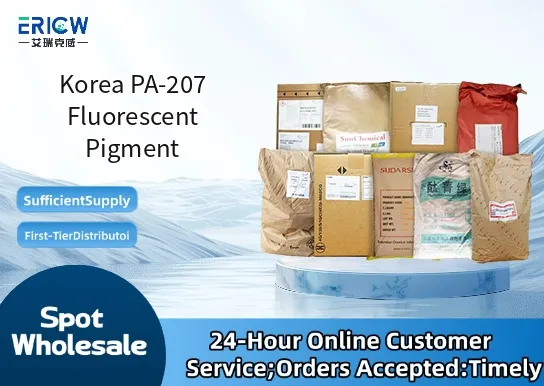
High-intensity fluorescence under UV-A (365 nm) and daylight conditions.
Excellent thermal stability up to 220°C, suitable for high-temperature processing.
Good dispersibility in both polar and non-polar polymer matrices.
Low migration tendency in PVC, ABS, PS, and polyolefin systems.
Compliant with REACH and RoHS directives for restricted substances.
Safety signage and emergency exit markings.
Fluorescent inks for security printing and authentication labels.
UV-responsive masterbatches for industrial plastics.
High-visibility coatings for construction and transportation equipment.
Specialty films for optical sensors and photonic applications.
| Chemical Type | Organic fluorescent dye dispersed in inert polymer carrier |
| Product Form | Free-flowing granular concentrate |
| Appearance | Yellow-orange granules with uniform particle size |
| Primary Applications | Polymer coloring, UV-responsive inks, safety coatings |
| Key Features | UV-stable, non-bleeding, low-volatility |
| Benefits | Consistent color intensity, easy dosing, minimal filter clogging |
| Recommended Loading Range | 0.5–3.0 wt% depending on substrate and effect intensity |
| Storage Conditions | Keep in cool, dry place; avoid direct sunlight and moisture |
Q1: What types of resin systems is Korea PA-207 compatible with?
A: Korea PA-207 demonstrates good compatibility with a broad range of thermoplastic and thermosetting systems, including ABS, PS, PC, PMMA, PVC, and unsaturated polyester resins. Performance may vary depending on processing temperature and residence time, so preliminary dispersion and compatibility testing is recommended for each specific formulation.
Q2: How does PA-207 perform under UV exposure and outdoor weathering?
A: As a fluorescent pigment, PA-207 delivers strong chromatic intensity under UV illumination but is not inherently UV-stabilized. Prolonged direct UV exposure or harsh outdoor conditions may lead to gradual fluorescence attenuation. For extended outdoor service life, co-addition of appropriate UV absorbers and HALS stabilizers is strongly advised.
Q3: What is the recommended method for incorporating PA-207 into polymer melts?
A: For optimal dispersion and fluorescence uniformity, PA-207 should be introduced via masterbatch dilution or high-shear compounding—avoid dry blending directly into final formulations. Pre-drying is not typically required, but ensure the carrier resin in masterbatches matches the base polymer system to minimize interfacial issues.
Q4: Is PA-207 suitable for applications requiring food contact compliance?
A: Korea PA-207 is intended for industrial and decorative applications only. It is not certified for food-contact use, nor is it formulated to meet regulatory requirements for migration control in food packaging or utensils. Customers requiring food-safe alternatives should consult our dedicated food-grade pigment portfolio.
Contact With Us:
E-mail: wangxingqiang@ericwchem.com
Have a Questions? Call Us:
Add:
Building A1, Jiete Industrial Park, Huangpu District, Guangzhou City, Guangdong Province, China