English
 Español
 tiếng việt
 русский
Excellent abrasion resistance for extended service life in demanding mechanical environments.
Superior elasticity and recovery performance, maintaining shape integrity after repeated deformation.
Good low-temperature flexibility down to –30 °C without significant stiffness increase.
Outstanding oil and grease resistance, suitable for contact with hydrocarbon-based lubricants.
High transparency and clarity with minimal yellowing after UV exposure and thermal aging.
Transparent protective films for electronic displays and touch panels.
Soft-touch overmolding for automotive interior trim and control knobs.
Medical tubing requiring biocompatibility and kink resistance.
High-clarity gaskets and seals for optical and precision instrumentation.
Wearable device components including wristbands and sensor housings.
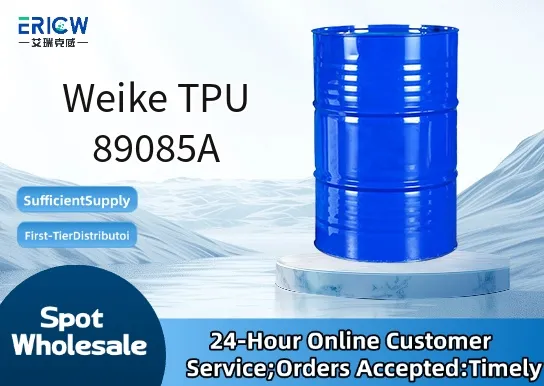
| Chemical Type | Aliphatic polyester-based thermoplastic polyurethane |
| Product Form | Pellets |
| Appearance | Transparent, translucent granules |
| Hardness (Shore A) | 85 ± 2 |
| Melt Flow Index (230 °C/2.16 kg) | 15–20 g/10 min |
| Density | 1.18–1.20 g/cm³ |
| Primary Applications | Transparent elastomeric parts, soft-touch overmolding, medical-grade flexible components |
| Key Features | UV-stable, hydrolysis-resistant, FDA-compliant raw material grade |
Q1: What is the primary functional role of Weike TPU 89085A in thermoplastic polyurethane formulations?
A: Weike TPU 89085A functions as a high-performance processing aid and melt-flow modifier, enhancing extrudability, reducing melt viscosity, and improving surface finish in TPU-based compounds—particularly during film casting, profile extrusion, and injection molding.
Q2: Is Weike TPU 89085A compatible with both aromatic and aliphatic TPU base resins?
A: Yes, it demonstrates broad compatibility across common aromatic and aliphatic TPU grades, including polyester- and polyether-based systems. Compatibility should be confirmed via small-scale trials under intended processing conditions.
Q3: How does Weike TPU 89085A affect the mechanical properties of the final TPU product?
A: When used within recommended dosage ranges, it maintains key mechanical attributes—including tensile strength, elongation at break, and abrasion resistance—while optimizing processability. Significant over-addition may reduce hardness or modulus, so dosage should be balanced against performance priorities.
Q4: What are the recommended storage and handling conditions for Weike TPU 89085A?
A: Store in original sealed packaging in a cool, dry, well-ventilated area away from direct sunlight and sources of heat or ignition. Avoid prolonged exposure to ambient humidity prior to use, as moisture absorption may affect dispersion efficiency during compounding.
Contact With Us:
E-mail: wangxingqiang@ericwchem.com
Have a Questions? Call Us:
Add:
Building A1, Jiete Industrial Park, Huangpu District, Guangzhou City, Guangdong Province, China