English
 Español
 tiếng việt
 русский
High elasticity and excellent recovery performance after repeated deformation.
Good processability on standard thermoplastic injection molding and extrusion equipment.
Outstanding resistance to UV radiation and thermal aging under ambient conditions.
Low compression set, ensuring long-term sealing integrity in dynamic applications.
Halogen-free formulation compliant with RoHS and REACH environmental directives.
Automotive interior trim components including soft-touch door panels and dashboard overlays.
Consumer electronics housings requiring tactile comfort and impact absorption.
Sealing rings and gaskets for HVAC systems and fluid-handling assemblies.
Medical device grips and ergonomic handles where skin contact safety is critical.
Industrial tool overmolding for enhanced grip, vibration damping, and user safety.
| Chemical Type | Thermoplastic Elastomer (TPE), Styrenic Block Copolymer (SBC)-based |
| Product Form | Pellets |
| Appearance | Translucent off-white granules |
| Hardness (Shore A) | 50 ± 3 |
| Melt Flow Rate (2.16 kg, 200 °C) | 28–32 g/10 min |
| Density | 0.98–1.00 g/cm³ |
| Tensile Strength | ≈7.5 MPa |
| Elongation at Break | ≈420% |
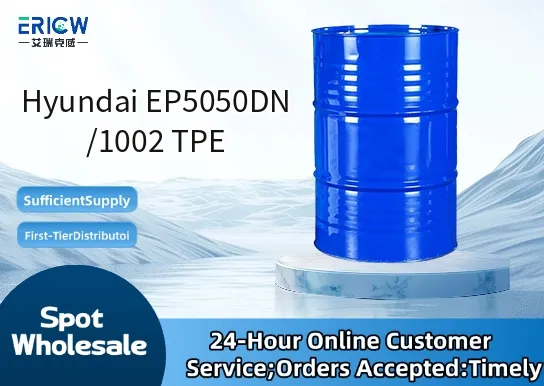
Q1: What is the primary polymer base of Hyundai EP5050DN/1002 TPE?
A: Hyundai EP5050DN/1002 TPE is a thermoplastic elastomer based on a styrenic block copolymer (SBC) architecture, combining polystyrene end blocks with mid-blocks of saturated or partially saturated rubbery segments to deliver balanced melt processability and elastic recovery.
Q2: Is this grade suitable for overmolding onto polypropylene (PP) or polyethylene (PE) substrates?
A: Yes — EP5050DN/1002 is specifically formulated to provide good interfacial adhesion to polyolefin substrates such as PP and HDPE when used in two-shot or insert molding processes, without requiring pre-treatment or adhesive primers under standard processing conditions.
Q3: What are the typical processing temperature ranges for injection molding this TPE?
A: Recommended melt temperatures generally range from 180 °C to 220 °C, depending on part geometry and equipment. Mold temperatures are typically maintained between 20 °C and 40 °C to ensure efficient cycle times and surface quality.
Q4: Can this material be used in applications requiring skin-contact safety compliance?
A: While EP5050DN/1002 is not pre-certified to specific regulatory frameworks, it is formulated without intentionally added heavy metals, phthalates, or halogenated flame retardants. Formulators may develop compliant compounds meeting general skin-contact requirements through appropriate compounding and third-party testing.
Contact With Us:
E-mail: wangxingqiang@ericwchem.com
Have a Questions? Call Us:
Add:
Building A1, Jiete Industrial Park, Huangpu District, Guangzhou City, Guangdong Province, China