English
 Español
 tiếng việt
 русский
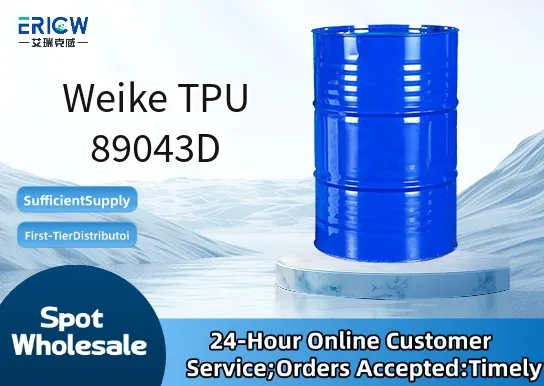
Excellent abrasion resistance for extended service life in demanding mechanical environments.
Outstanding low-temperature flexibility down to –40 °C without brittle failure.
Good oil and grease resistance suitable for intermittent contact with hydrocarbon-based fluids.
High tensile strength and elongation at break, enabling reliable performance under dynamic stress.
Compatible with common thermoplastic processing methods including extrusion, injection molding, and calendering.
Industrial hoses and pneumatic tubing requiring flexibility and pressure resilience.
Automotive interior trim components such as gear knobs, armrest covers, and soft-touch surfaces.
Protective casings and overmolded grips for power tools and handheld electronic devices.
Wear-resistant conveyor belts and scraper blades in material handling systems.
Seals and gaskets for non-critical fluid containment applications in general machinery.
| Chemical Type | Thermoplastic Polyurethane (TPU), Polyester-based |
| Product Form | Pellets |
| Appearance | Off-white to light beige, free-flowing granules |
| Shore A Hardness | 85–89 |
| Tensile Strength (MPa) | 32–38 |
| Elongation at Break (%) | 450–520 |
| Density (g/cm³) | 1.18–1.22 |
| Melt Flow Index (g/10 min, 210 °C/2.16 kg) | 10–14 |
Q1: What is the primary functional role of Weike TPU 89043D in thermoplastic polyurethane formulations?
A: Weike TPU 89043D functions as a high-performance processing aid and melt-flow modifier, designed to enhance extrudability, reduce melt viscosity, and improve surface finish in TPU-based compounds—particularly during film blowing, calendering, and injection molding.
Q2: Is Weike TPU 89043D compatible with both aromatic and aliphatic TPU base resins?
A: Yes, it demonstrates broad compatibility across common aromatic and aliphatic TPU grades, including polyester- and polyether-based systems. Compatibility should be verified under actual processing conditions due to formulation-specific variables such as molecular weight distribution and additive load.
Q3: How does Weike TPU 89043D affect the mechanical properties of the final TPU product?
A: At typical usage levels, it maintains key mechanical attributes—including tensile strength, elongation at break, and tear resistance—while significantly improving process stability. Over-addition may lead to slight reductions in modulus or hardness, so dosage should be optimized per application requirements.
Q4: What are the recommended storage and handling conditions for Weike TPU 89043D?
A: Store in original sealed packaging at temperatures between 5 °C and 30 °C, protected from moisture, direct sunlight, and contamination. Prior to use, ensure material is dry—especially if processing involves high-temperature operations where residual moisture could cause surface defects or hydrolysis.
Contact With Us:
E-mail: wangxingqiang@ericwchem.com
Have a Questions? Call Us:
Add:
Building A1, Jiete Industrial Park, Huangpu District, Guangzhou City, Guangdong Province, China