English
 Español
 tiếng việt
 русский
Excellent abrasion resistance for extended service life in demanding mechanical environments.
High elasticity and outstanding rebound resilience, enabling dynamic performance under cyclic loading.
Good processability via injection molding and extrusion, supporting high-volume manufacturing.
Enhanced hydrolytic stability compared to standard polyester-based TPUs, suitable for humid or wet conditions.
Low-temperature flexibility down to –30 °C without significant loss of mechanical integrity.
Industrial rollers and conveyor belt components requiring wear resistance and dimensional stability.
Automotive interior trim parts including gear knobs, steering wheel covers, and soft-touch overlays.
Footwear midsoles and outsoles where energy return and durability are critical.
Medical tubing and non-implantable device housings leveraging biocompatibility (ISO 10993 tested) and clarity.
Consumer electronics protective cases and flexible cable jackets with impact absorption and surface gloss retention.
| Chemical Type | Polyester-based thermoplastic polyurethane (TPU) |
| Product Form | Pellets |
| Appearance | Translucent, natural-colored granules |
| Hardness (Shore A) | 90 ± 2 |
| Melt Flow Index (230 °C / 5 kg) | 10 ± 2 g/10 min |
| Density | 1.18–1.20 g/cm³ |
| Key Features | High elasticity, abrasion resistance, hydrolysis resistance, low-temperature flexibility |
| Primary Applications | Industrial components, automotive interiors, footwear, medical devices, consumer electronics |
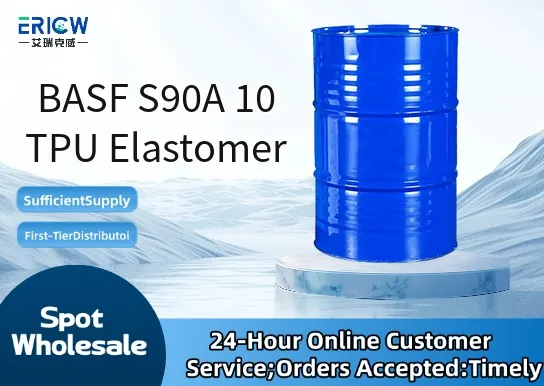
Q1: What is the primary function of BASF S90A 10 in thermoplastic polyurethane (TPU) formulations?
A: BASF S90A 10 is a specialized TPU elastomer grade designed to enhance melt processability and improve mechanical resilience in extruded or injection-molded TPU parts, particularly where balanced hardness, elasticity, and surface finish are required.
Q2: Is BASF S90A 10 compatible with other common TPU grades or polymer blends?
A: Yes, S90A 10 exhibits good compatibility with standard aromatic and aliphatic TPU resins, as well as certain polyester- and polyether-based TPUs. Blending should be evaluated case by case for phase morphology and thermal stability, especially under extended processing conditions.
Q3: What processing methods are recommended for BASF S90A 10?
A: This grade is optimized for conventional thermoplastic processing techniques including injection molding, extrusion, and blow molding. Pre-drying is strongly recommended prior to processing to maintain optimal melt viscosity and mechanical performance.
Q4: Does BASF S90A 10 offer any specific advantages for flexible thin-walled applications?
A: Yes — its controlled melt elasticity and low compression set support consistent wall thickness, reduced warpage, and excellent recovery in flexible components such as seals, gaskets, and soft-touch overmolds.
Contact With Us:
E-mail: wangxingqiang@ericwchem.com
Have a Questions? Call Us:
Add:
Building A1, Jiete Industrial Park, Huangpu District, Guangzhou City, Guangdong Province, China